
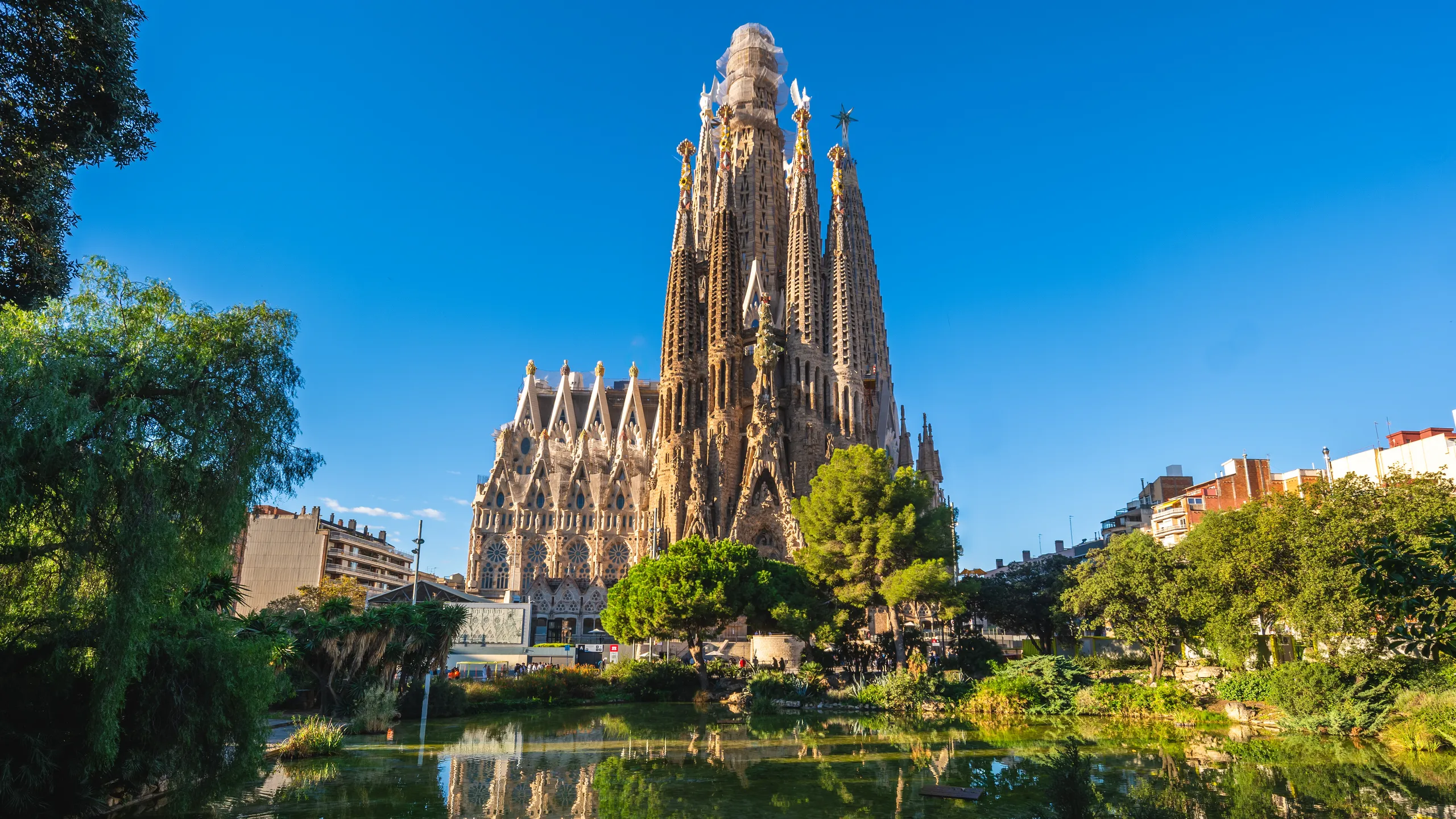
Buying a ticket for the Sagrada Familia seems simple, but there are three pitfalls: the offer is not a tiered system but a matrix, choosing a tower is not irrelevant even if it costs the same, and there are written access rules that surprise many people at the entrance. Let's break it down.
The four inputs are arranged in a matrix, not a staircase
Almost all of Barcelona's monuments offer different levels of access: each one includes what the previous one does and adds something extra. Here, it's different. There are two independent decisions – whether you want a guided tour with a real person, and whether you want to go up to the tower – and the four tickets represent the four possible combinations.
| Formula | Live guide | Tower | Declared duration |
|---|---|---|---|
| Basic | No | No | Free |
| With guided tour | Yes | No | Approximately 50 minutes |
| With tower | No | Yes, one to choose | Free |
| With guided tour and tower access | Yes | Yes, one to choose | Approximately an hour and a half |
What's always included, and what many people don't realize they've already paid for: the audio guide in nineteen languages, in a long version of about forty-five minutes or an express one of twenty-five, plus guided visits in Catalan, Spanish, and International Sign Language. What the guided visit doesn't include, on the other hand, is the museum, the liturgical route, and, obviously, the towers.
Birth or Passion: The choice that no one explains
If you buy a ticket that includes access to a tower, you have to choose which one, and they cost the same. The official website dedicates eleven words to that decision, and its frequently asked questions don't have a single mention of the towers. It's not hidden information: it's information that doesn't exist, and that's why each website invents it or copies it from another.
The only thing the basilica states is where to look: from the Nativity tower, you can see the eastern side of the city; from the Passion tower, you can see the city center. That's not much. But there is a much better criterion, and it is documented.

The working criteria
It's a choice between 1925 and 1976
Whoever climbs the tower of the Nativity climbs on stone laid while Gaudí was alive and directing the work: the bell tower of Saint Barnabas was completed in November 1925, seven months before his death, and it was the only thing he saw finished. Whoever climbs the one of the Passion climbs on bell towers built between 1954 and 1976, thirty years later, following his design but with other hands.
It's important to state this accurately, because the simplified version is unfair. The façade of the Passion is indeed a project by Gaudí: he completed it entirely in a drawing he made during an illness, so detailed that, according to the basilica itself, even a plaster model was not necessary. What is not his is the sculpture, which is by Subirachs. So, the correct phrase is not "the other one is not by Gaudí," but rather "the other one, Gaudí never saw it."
And a warning about a very frequently repeated number. The figure of 504 steps is circulating on dozens of websites, and it does not appear in any document of the basilica: neither on the ticket page, nor in the frequently asked questions, nor on the blog. The most consulted third-party source in the world says "more than 300." The two most widely circulated figures do not even match each other. Also, the height reached by visitors is not published: the 55, 65, or 75 meters that are mentioned are not verified.
The rules of the towers are stricter than they appear
You go up in an elevator and you go down on foot, via a narrow spiral staircase. The elevator does not come down with you. From that point on, everything else is outlined in the regulations:
- Children under 6 are not allowed. Between 6 and 16, they must be accompanied by an adult.
- It is not accessible for people with reduced mobility or functional diversity. The basilica states it this way: the entire temple is accessible, except for the towers.
- The regulations themselves advise against those who have vertigo, claustrophobia, anemia, a tendency to feel dizzy, or heart or respiratory problems from going up. This is not just a formality; it is explicitly listed.
- Backpacks and bags must be checked before going up. The cloakroom is only for those who are going up.
- The towers close if the weather is bad. If that happens, the amount for the additional service will be refunded, not the entire ticket.
- In school visits, one teacher is required for every ten students.
If anyone in your group has a serious problem with heights or enclosed spaces, the honest recommendation is not to "choose the easier tower": there is no publicly available information that distinguishes the two staircases. The recommendation is to skip the tower altogether and stick to the interior, which is the best part of the building anyway.
There is a dress code, and it is clearly defined
It's one of the most frequently asked questions, and almost all websites provide answers based on hearsay. The official regulations have a dedicated section, and they are stricter than most people assume. It is not allowed to enter wearing clothing with sheer fabrics, tank tops that do not cover the shoulders, or swimwear. Pants and skirts must cover the mid-thigh at a minimum. It is also not allowed to enter barefoot, or wearing a cap or hat inside the basilica and the museum, except for religious or health reasons. In the Chapel of the Blessed Sacrament, in addition, bare shoulders are not permitted.
Summarized in two rules that are easy to remember: covered mid-thigh and covered shoulders. In August, with temperatures reaching thirty degrees, it's a good idea to know this before leaving the hotel.
Who pays less
| Who | What's the rate? |
|---|---|
| Under 11 years old | Free |
| People with disabilities | Free. One guest enters free with the purchase of a basic ticket |
| Under 30 years old | Reduced |
| Student ID holders | Reduced |
| Pensioners | Reduced |
| Groups of 10 or more | Our own rate, and with a mandatory official guide from the Generalitat (regional government) |
| School groups | Dedicated rate; the teacher does not pay |
The under 30 age range is unusual: no other Gaudí monument offers it. If you are in your twenties, this is a discount that you don't have to be a student to take advantage of.
Reservations: Required, made online, and with no flexibility
Advance purchase is mandatory to enter the premises, and tickets are only sold online. The legitimate channels are the basilica's website, its sales platform, and authorized distributors; resale is prohibited, and photo identification is required for entry.
Regarding the time slot, the rule is strict, and it's best to read it twice: the tickets are only valid for the chosen time slot; if you arrive late, you will not be allowed to enter. There is no grace period of half an hour, as there is at Park Güell. Changes and refunds are accepted with at least 48 hours notice, with a fifteen-day deadline to claim, and the refund is nominal: only to the person who purchased the ticket.
Inside, you cannot leave and re-enter once admission has been validated; eating and smoking are not allowed, and eviction begins fifteen minutes before closing.
Is there free admission?
As a visitor, please note: there are no open house days or free admission for the general public. What does exist is the worship: access to masses is free, but with limited capacity and through a different entrance. The basilica delays the opening to tourists on Sundays precisely because of this.
It's important to understand what is and isn't allowed. You are attending a celebration, not touring the temple. There is no audio guide, you cannot access the museum or the towers, and you cannot move around freely. Attending mass simply to "avoid the entrance fee" is a bad idea and shows a lack of respect for those who are praying.
What time should I go, based on the light?

The piece of information that determines whether or not someone will visit
Blue in the morning, orange in the afternoon
The stained glass windows on the side of the Nativity, to the east, are blue and green; those on the side of the Passion, to the west, are orange and red. In the morning, one side is illuminated, and in the afternoon, the other; the interior is literally another building. During the central hours, the skylights in the ceiling are primarily responsible for the light.
There's a seasonal nuance that no guide mentions, and it changes the advice. In winter, the sun rises late, and the facade of the Nativity receives direct sunlight for just over an hour, most of which is before the basilica opens. The blue light of the morning is, for those who visit, a phenomenon of spring and summer. The warm light of the afternoon, on the other hand, falls within the opening hours all year round. If you travel in December and want color, go in the afternoon.
Accessibility
The entire temple is wheelchair accessible, except for the towers, and wheelchairs are available for loan at the Marina Street entrance. Dogs are not allowed, with the exception of service dogs. Tripods are prohibited, as is professional photographic equipment, and photography is strictly prohibited during mass.
Before you enter, understand what you are about to see
Why doesn't it have buttresses? What does each facade represent? And where do the 172.5 meters come from?
FAQ
Which tower is better, the Nativity tower or the Passion tower?
How many steps are there to go down?
Is there a dress code?
Can I go up to the tower with children?
What happens if I arrive late?
Is it possible to visit for free by attending mass?
How long does the visit last?
Data verified on. Ticket types, discounts, access regulations, dress code, and tower rules: sagradafamilia.org, sections on tickets, schedules, and regulations.