
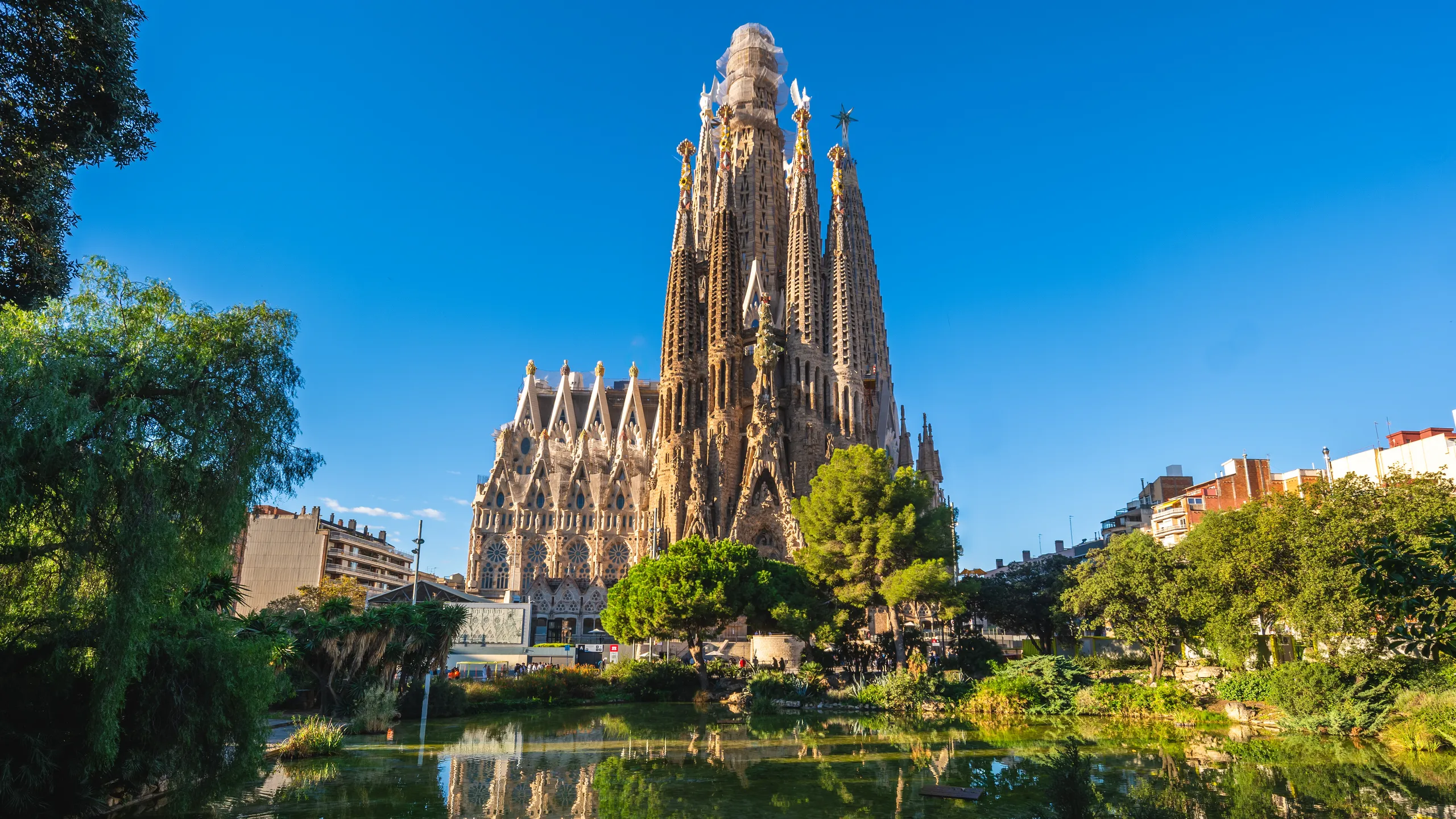
There's a quick way to be misled about Gaudí, and it's by relying solely on the signature. There are projects attributed to him that he didn's actually design, there's a work of his that he refused to sign, and entire buildings where the elements that are most admired were created by someone else. This isn't a minor detail; it's the reason why each website lists a different number of works and why none of them explain how they've determined authorship.
This page addresses that very issue, which is something that almost no one talks about, and from here, you can access the other six sections: the life [of the subject], the method [used], the era, the centennial, the catalog of what remains standing, and the list of what was lost or never built.
A signature does not prove authorship
Francesc Berenguer i Mestres (1866-1914) left his architecture studies in 1888 without graduating. Without a degree, he couldn't sign a project, so someone else would sign it, and that someone was often Gaudí. The Col·legi d'Arquitectes de Catalunya states it plainly: "it is common to find projects of his signed by Gaudí." Berenguer worked alongside him from 1887 until his death; the COAC attributes twenty-one works to him, and when Gaudí died, he said he had lost his right hand.
The opposite case also exists, and there is only one. The Xalet del Catllaràs, in Pobla de Lillet, is by Gaudí, and Gaudí never claimed it. A study by Galdric Santana, from the Real Cátedra Gaudí at UPC, commissioned by the Generalitat, confirmed this in February 2026: the project is his, but he did not oversee the work, which was executed and modified by others. What was ultimately built was not what he had designed, and he preferred not to put his name on it. Those seeking consistency will find this: he signed projects by others out of friendship, and he did not sign his own when he did not recognize the result.

Something that bears its name, but isn't entirely its own
The salamander on the staircase, the mosaics in the hypostyle hall, and the bench in Park Güell are mentioned everywhere as inventions of Gaudí. The park itself acknowledges that the bench was designed by Josep Maria Jujol, who joined the studio before becoming an architect: he obtained his degree on May 18, 1906. Where one ends and the other begins is the subject of the methodology page, and in several pieces, there is no definitive answer.
Between these two extremes lies a gray area that guides often resolve with a simple "yes" or "no." The honest approach is to explain who holds each viewpoint and allow the reader to understand the extent of the uncertainty.
| Work | What's being discussed | What the sources say |
|---|---|---|
| Xalet del Catllaràs (located in La Pobla de Lillet) | If it's by Gaudí | Yes, it is. A study by Galdric Santana, from the Real Gaudí Chair, confirmed this in February 2026: the project was his, but the execution was not, and that's why he never claimed ownership of it |
| Güell Wineries (Garraf) | Gaudí or Berenguer | Most scholars attribute them to Berenguer. Bassegoda, on the other hand, speaks of collaboration between the two |
| Artigas Gardens (La Pobla de Lillet) | If they are yours | The provincial government registry lists them as "Antoni Gaudí (?)," with the question mark added by the registry itself, and the regional government states that there is no document to confirm this |
| Gaudí House Museum (Park Güell) | Who designed the house where they lived? | The Park Güell and the Sagrada Família attribute the design to Francesc Berenguer; the archive of the Real Cátedra Gaudí states that the two of them designed it together |
| Bank and medallions at Park Güell | How much is Jujol? | The park itself acknowledges that the bank was designed by Josep Maria Jujol, and the medallions in the hypostyle hall are widely attributed to him |
| Casa Bofarull (Els Pallaresos) | It is mistakenly attributed to him | It doesn't belong to them. It was created by Josep Maria Jujol between 1914 and 1930, for the sisters Dolors and Pepita Bofarull |
Directing is not the same as projecting
There is a third confusion, more subtle than the previous two: in several works signed by Gaudí, the actual direction came from someone else. El Capricho of Comillas was directed by Cristòfol Cascante, a colleague from the same graduating class, who received his degree on the same day as him, March 15, 1878, working on a model that Gaudí had prepared. Whether Gaudí actually visited Comillas is a question that the museum itself leaves open, and which is complicated by the fact that he had already worked there in 1881, on the kiosks. In the cathedral of Palma, the actual direction was by Joan Rubió i Bellver, and the decoration was by Jujol. In the Torre Bellesguard, Rubió also oversaw the integration of the castle remains, and Jujol completed the viaduct.
The most uncomfortable case is the Casa Vicens. Gaudí rejected the 1925 expansion because he was dedicated to the temple, and he himself appointed Joan Baptista Serra de Martínez to carry it out. Serra demolished and replaced Gaudí's original staircase, closed off the tribune with stained glass windows, and added a tower-minaret almost identical to the original. In 1928, he won the municipal award for artistic buildings with this expansion, the same award that Casa Calvet had received in 1900. A large part of what is seen today in Casa Vicens is the work of Serra, chosen by Gaudí to replace him.
The ground that everyone walks on
The most iconic design attributed to Gaudí was not actually created by Gaudí. The hexagonal pavement stone of Passeig de Gràcia was designed in 1904 for the Casa Batlló, and the relief was defined by modeling it directly in wax with his fingers. Manufacturing delays meant that it was never installed there: the pieces ended up in the service areas and kitchens of Casa Milà. Escofet produced it between 1906 and 1964. It finally reached the sidewalk of Passeig de Gràcia in 1971, forty-five years after his death, and the tile that is walked on today is the redesign from 1997, with the relief inverted. Gaudí never saw his design on a sidewalk.
The motifs are starfish, ammonites, and algae, although another interpretation sees an octopus, a sea snail, and the starfish. Each piece shows a third of each, so you need seven tiles in a row to see the three complete designs. They cover 60,000 square meters of Passeig de Gràcia and should not be confused with the four-petal flower pavement, which is the standard paving of the city and has nothing to do with it.

Originality lies in returning to the source.
Six ways to follow
Each one answers a different question about the same man.

Antoni Gaudí biography
Reus or Riudoms, the family of blacksmiths, the brothers who died, the arrest of 1924, and the tram accident, with evidence provided for each detail and any gaps acknowledged.

The Gaudí Method: Geometry and Nature
The model, hanging upside down from the ceiling, shows the four defined surfaces and where each can be seen. It also depicts the catenary arches of each building and indicates which parts of the mosaic work are by Jujol.

Gaudí and Catalan Modernism
Depending on who you ask, the beginning of Modernism can be traced to various factors, including the five buildings in the "Block of Discord," and the municipal ordinance that made the facades on Passeig de Gràcia possible.

Catalog of Gaudí's works
What still stands, with the counting criterion stated, the current condition of each work, its legal protection, and the works wrongly attributed to him.

Lost works and those that were never built
What was burned down, what was demolished, and what only existed on paper, including the Attraction Hotel in New York.

Gaudí Centennial: 1926-2026
The Mass on June 10th, the blessing of the Christ the Redeemer statue, the 31 events at the basilica, and what the centennial celebration didn't manage to complete.
And the works, one by one
Casa Vicens, Palau Güell, Torre Bellesguard, the crypt of the Colònia Güell, and what can be seen for free from the street.
FAQ
Are all the works attributed to Gaudí actually his?
Is there any work by Gaudí that he wouldn't recognize?
Is the bench in Park Güell designed by Gaudí?
Did Gaudí oversee all of his works?
Is the paving on Passeig de Gràcia designed by Gaudí?
Where can I find a complete list of their works?
Data verified on. Sources: COAC records, the archive of the Real Cátedra Gaudí, the registry of the Diputació de Barcelona, a study by Galdric Santana (2026), and the organizations responsible for managing each project.