

Puig i Cadafalch, a contemporary of Gaudí
Two tickets, priced at €21 and €23, and the comparison that gives meaning to the whole area.
There are only two options available, and the same provider sells both: €21 for the audio guide and €23 for the guided tour. Civitatis, which is where many Spanish-speaking travelers look first, doesn't offer either option, and neither does Viator. So, the real choice isn't between ten different products; it's between two that differ by only two euros. This website truly compares them and then does what's needed here, which is to explain why this building is best understood when viewed alongside its neighbors. That's exactly how Puig i Cadafalch envisioned it.
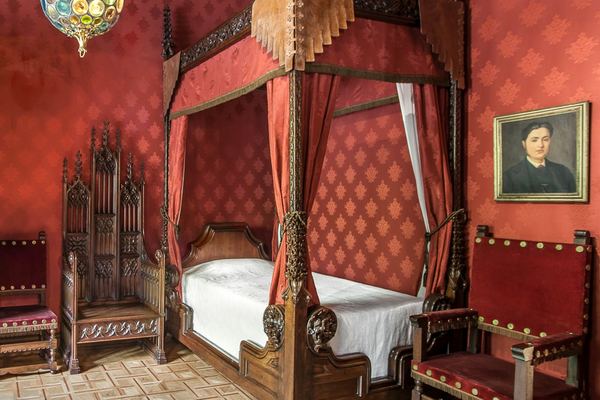
It's worth mentioning upfront what you're seeing. The tour includes the entrance hall, the staircase, the main floor with its original furniture, and the shop, where you can find chocolate. The visit takes about an hour. It's not a building you explore from top to bottom, and those expecting a grand, expansive building might be disappointed. However, if you're interested in seeing a bourgeois home from the early 1900s, preserved as it would have been lived in, you're likely to be satisfied, and you're also done relatively quickly, which is a plus, especially given its location on Passeig de Gràcia.
Casa Amatller: Enjoy the chocolate house without the queues
The house that Puig i Cadafalch designed for the chocolatier Antoni Amatller, featuring dragons and knights on its facade, is located next to Casa Batlló.

Casa Amatller with a guided tour and a box of chocolate leaves
The tour is narrated by the owner himself, who shares stories about his travels and his chocolate business, and concludes with a box of Amatller chocolates.
Ratings collected by Tiqets

1898-1900
A house designed to be admired alongside its neighbors
Puig i Cadafalch didn't build the Casa Amatller from scratch; instead, he completely renovated a building from 1875 for Antoni Amatller, who manufactured chocolate and was also a photographer, traveler, and collector. The commission was typical for the time: a residence for the family, with the remaining space intended for rental. The facade was where the prestige was truly showcased.
What he did was bring a tiered fountain from Northern Europe, install it on Passeig de Gràcia, and cover it with glazed ceramic. Beneath the fountain, the stone is sculpted with animals performing various trades: some are blowing glass, others are melting metal, and some are molding chocolate. These are the trades that paid for the house, depicted on the facade with a good sense of humor.
The two options, and how they differ
| What is it? | Price | How to navigate | Chocolate | Notes and reviews |
|---|---|---|---|---|
| Skip-the-line entry with audio guide | €21 | At your own pace | Tasting in the kitchen | 4.7 (399 reviews) |
| Guided tour | €23 | In a group, with a live guide | Takeaway box | 4.7 stars (141 reviews) |
There's a two-euro difference, and both receive the same rating, 4.7, although the audio guide has nearly three times as many reviews. What truly changes isn't the price, but the type of experience. The audio guide allows you to stop and focus on what interests you; the guided tour takes you along. In a house of this scale, where the tour is short and you need to pay attention to small details, the guided tour has a distinct advantage: it tells you where to look. The audio guide, on the other hand, offers the benefit of not rushing you in the dining room.
And then there's the chocolate, which in this place isn't just a trivial souvenir. The €21 option allows you to sample it right there, in the original kitchen. The €23 option gives you a box to take away. If you were planning to buy chocolate in the shop anyway, those extra two euros are already worth it, and you'll even have change left over.
The "Apple of Discord," with the apartment numbers
The section of Passeig de Gràcia between Consell de Cent and Aragó features five consecutive buildings, and each one is the work of a different architect. The building numbers are important because almost no guidebooks mention them: at number 35 is the Casa Lleó Morera, by Domènech i Montaner; at number 37 is the Casa Mulleras, by Enric Sagnier; at number 39 is the Casa Bonet; at number 41 is the Casa Amatller; and at number 43 is the Casa Batlló, by Gaudí.
It's important to clarify a common misconception found in many guides: the three famous buildings are not directly adjacent to each other. Amatller and Batlló are indeed connected, sharing a common wall, which is why they often appear together in photos. Lleó Morera, on the other hand, is located on the opposite corner of the block, with two less well-known houses in between. Those who arrive expecting to see three buildings in a row will likely spend some time looking in the wrong place.
And the name only works in Spanish. In Catalan, "casa" (house) is illa, and "manzana" (apple) is poma, so the play on words with the "apple of discord" from mythology is completely lost when it's translated. It's the only case I know of in Barcelona where the joke survives better in the foreign language than in the local one.

Scratching
Gold on the wall, and a reason to visit twice
The facade is not just made of stone: between the balconies, there is sgraffito, a technique that involves layering stucco and scratching the top layer to reveal the one underneath. In this case, the underlying layer is made of gold leaf, so the design changes with the time of day, and in the late afternoon, the entire surface seems to glow.
It's the best reason to pass by twice, once in the morning and once at sunset, and it doesn't cost a penny. It's also the part that has been most extensively restored: the sgraffito (a decorative technique) was almost lost and has been recreated, along with the rest of the facade, which reopened to the public in 2015 after a lengthy restoration.
Compared to the one next to it
The comparison is unavoidable because they share a wall, and it must be made honestly: Casa Batlló received 1.9 million visitors in 2024, it's significantly more expensive, and that's why most people stop on that side of the street. Amatller doesn't compete with that, nor does it try to. It doesn't publish its visitor numbers, and given the size of the main floor, it can't even come close.
What it offers is quite the opposite: small groups, one-hour tours, and a house that has preserved its original furnishings because Amatller's daughter, Teresa, left the house in the 1940s to an art history foundation, which still occupies the building. That's why what you see inside isn't a recreation with period furniture purchased from antique shops; it's the furniture that was actually there. This is quite rare on Passeig de Gràcia.
If you're planning to visit both, I recommend visiting Amatller first. It takes less time, and you'll leave with a clear understanding of what life was like in a house from the year 1900. Then, just a few steps away, is the other house. If you visit the smaller house first, you'll be overwhelmed and won't appreciate it properly.
It's good to see a grand building designed by an architect who isn't Gaudí.
Where it's not sold, and why that matters
A detail that changes the search: Civitatis does not sell the Casa Amatller. Neither the entrance, nor the guided tour, nor the chocolate activity. We checked this on August 25, 2026, through three different methods, and the result was the same each time. Viator also does not have any products. The two entries on this page are from Tiqets, and that is the only offering available in the three catalogs we use.
It's important because many people who speak Spanish start and end their search on Civitatis, find nothing, and assume that the house isn't open to the public. It is, in fact, open to visitors every day. The house next door is featured everywhere, while this one is mentioned almost nowhere, and it's not because it's closed: it's because no one has put it in the places where that audience looks.
There's a second gap, and this one relates to products: there is no item that connects the Casa Amatller with a work by Gaudí. We looked for a matching item the same day. Gaudí items are paired with Gaudí, Domènech items with Domènech, and the two adjacent houses on this block are purchased separately, even though they share a wall. It's not a decision made by anyone. It's a gap, and for now, it remains there.
Questions that keep coming up
Is the Casa Amatller designed by Gaudí?
No. It was designed by Josep Puig i Cadafalch between 1898 and 1900, four years before Gaudí began the renovation of number 43. The confusion is easily explained: they are located next to each other, they are from the same period, and the photos that circulate often show them together. However, they are two different houses, two separate commissions, and two different architects, and the beauty of seeing them side-by-side lies precisely in that contrast.
Which of the two options is more advantageous?
Both options cost €4.70, so neither is a bad choice. The €23 option includes a live guide and a box of chocolates to take away. The €21 option includes an audio guide and a tasting experience in the kitchen. For just two euros, the guided tour is worthwhile if you're interested in the family's history, which is a significant part of the house's appeal. If you're traveling with children or are short on time, the audio guide allows you to leave whenever you like.
Is there any area where admission is free?
Yes, you can visit the entrance hall. The ground floor has a shop with a café that you can access directly from the street, and from there you can see the beginning of the staircase and the stained-glass window of the courtyard. It's not a major attraction, but if you're passing by on Passeig de Gràcia and don't want to spend any money, it's a quick two-minute visit and it's free. However, you need to purchase a ticket to visit the upper floors.
Is there an entrance that connects the Casa Amatller and the Casa Batlló?
No, and it's not due to a lack of logic: they share a common wall. We checked all possible combinations in the three catalogs on August 25, 2026, and there is no combination that pairs a work by Puig i Cadafalch or Domènech i Montaner with a work by Gaudí. You have to purchase the tickets separately, and there is no discount for buying both.
How long does the visit last, and is it necessary to make a reservation?
It takes about an hour, and yes, it's worthwhile. Both options are scheduled at specific time slots, and the guided tours have small groups, so during peak season, the central time slots tend to sell out quickly. Outside of the summer months, it's often possible to find availability for the same day, especially in the early morning, which is also when Passeig de Gràcia is less crowded.
From the smallest apartment to the largest venue
If you only have an hour to spare, the Modernist Ensemble of Sant Pau, which covers nine city blocks, requires at least two. It represents the other extreme of the same movement, and admission costs 18€.
Data verified on. Prices, notes, and reviews listed in this catalog on August 25, 2026, regarding Viator, Tiqets, and Civitatis. The absence of Civitatis was confirmed through three different sources on the same day.