
Birth or Passion: Which tower of the Sagrada Familia is worth climbing, and who should avoid it
The basilica does, however, publish the difference in height between its two towers. We reviewed the pricing, FAQs, and terms of purchase on October 21, 2026: the height of each tower, the option to descend on foot, the health reasons that prevent people from climbing, and the refund policy that almost no one claims.
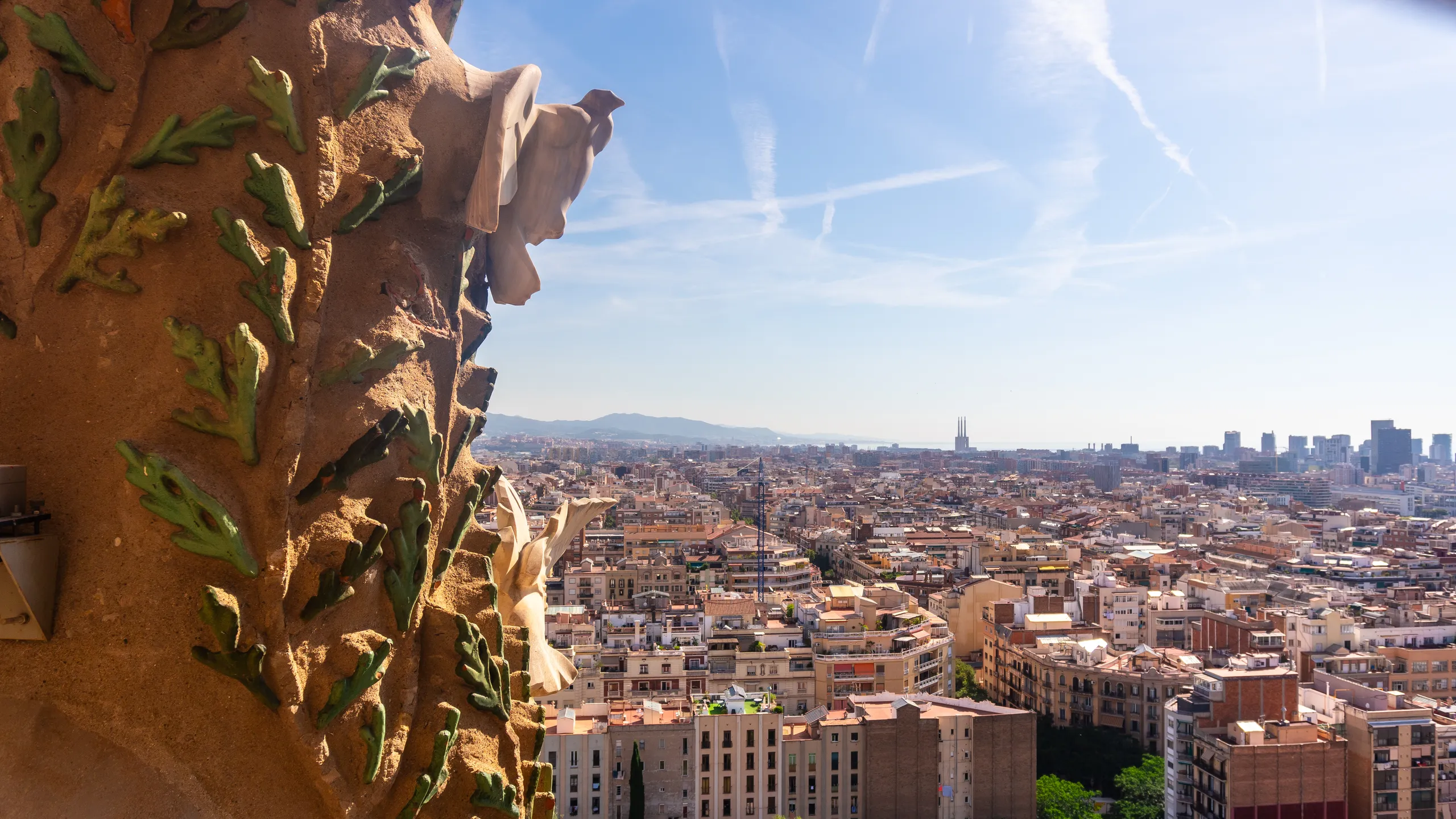
There's a decision that the Sagrada Família forces you to make before seeing anything of the building: which tower to climb. You don't choose at the door, nor do you change your mind inside. You choose by filling out the purchase form, between two options, and the terms of sale state it clearly: "anyone who purchases a ticket with access to one of the towers "must choose which of the two towers they wish to visit."
Almost everything that answers that question in Spanish consists of forum threads, old blog posts, and machine-translated product descriptions. They all repeat the same two or three phrases, and none of them mention where they got the information. And it turns out that the basilica does actually state what differentiates one tower from the other: it's in the product description, not in the frequently asked questions section, which is where everyone looks.
What follows was completely reviewed on October 21, 2026 on sagradafamilia.org: the pricing page, the frequently asked questions, the two admission tickets with tower access, and the complete terms and conditions of purchase, which is the document where the important details are and the one that no one ever reads.
The basilica publishes information about the direction each tower faces
It appears in the description for the "Sagrada Familia with tower" entry, repeated verbatim in the description for "guided tour and tower," and translated identically in the English and Catalan versions. It's a single sentence:
You can choose to climb the tower of the Nativity facade, which offers views to the east of the city, or the tower of the Passion facade, which offers views towards the city center.
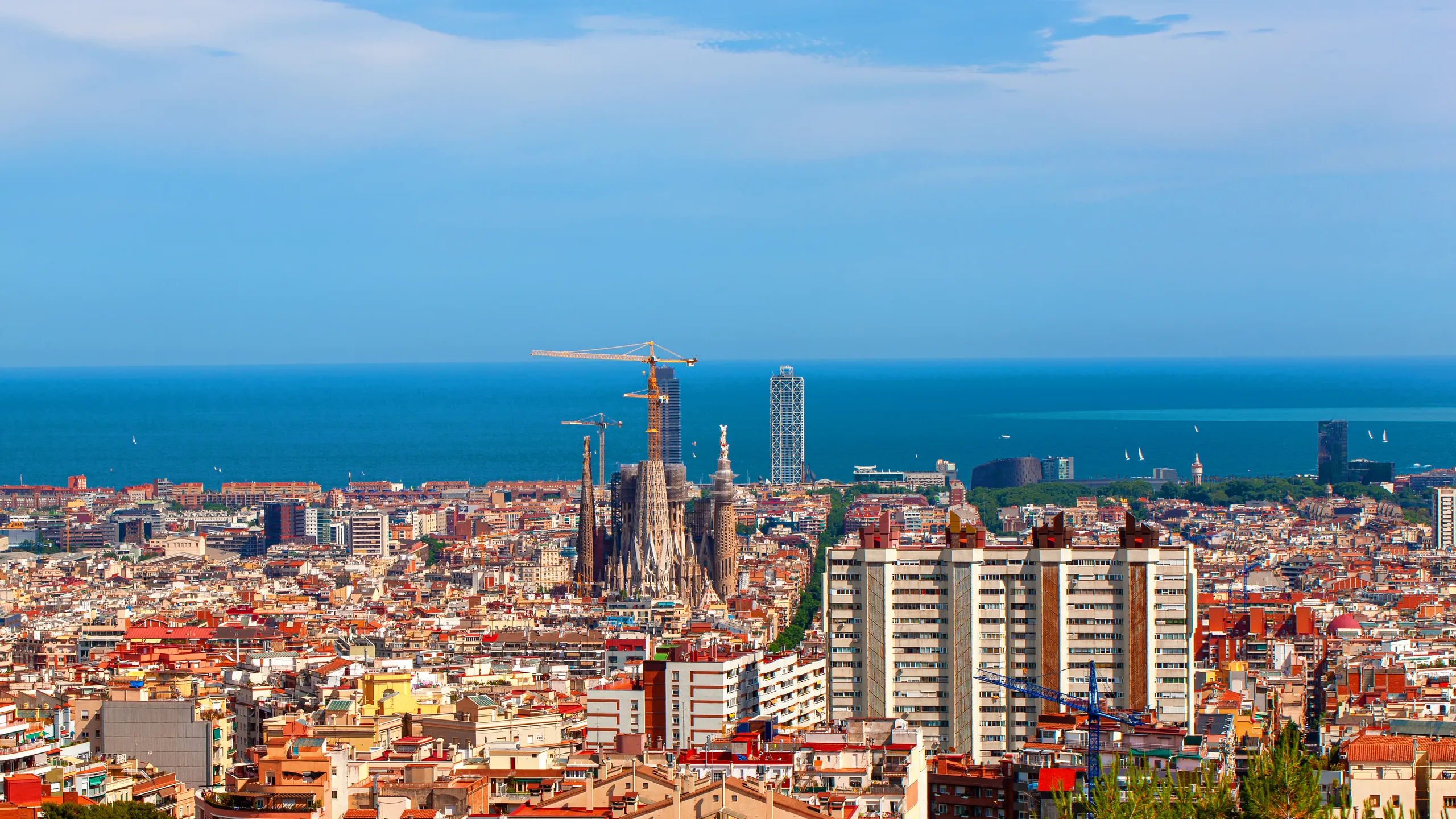
From the "Nacimiento" (Birth) side, the view looks towards the area where Barcelona slopes down to the water, with the Eixample district extending towards the sea, and the towers of Diagonal Mar in the distance. From the "Pasión" side, the view looks towards the city center, specifically towards the grid-like layout of the Cerdà plan, with Montjuïc mountain framing the horizon.
There isn't a "good" one and a "bad" one. There are two distinct photographs, and the choice is made somewhat blindly, because when you pay, no one shows you both views. The only thing the basilica guarantees in writing is the orientation. Everything else that's circulating – whether one staircase is wider, whether one has more light, or whether one offers a better view of the sculpted details – doesn't appear in any of the official pages that discuss the towers, and we've searched them all.
| Birth Tower | Passion Tower | |
|---|---|---|
| According to the official website, what is it looking at? | City center | City center |
| The facade | The only building constructed during Gaudí's lifetime | Erected after his death; sculptures by Josep Maria Subirachs |
| Price | €36 (or €40 with a guide) | €36 (or €40 with a guide) |
| Upload | Elevator | Elevator |
| Download | On foot | On foot |
| Number of steps | Not published | Not published |
| Width or clear opening of the staircase | Not published | Not published |
| Minimum age | 6 years | 6 years |
| Wheelchair accessible | No | No |

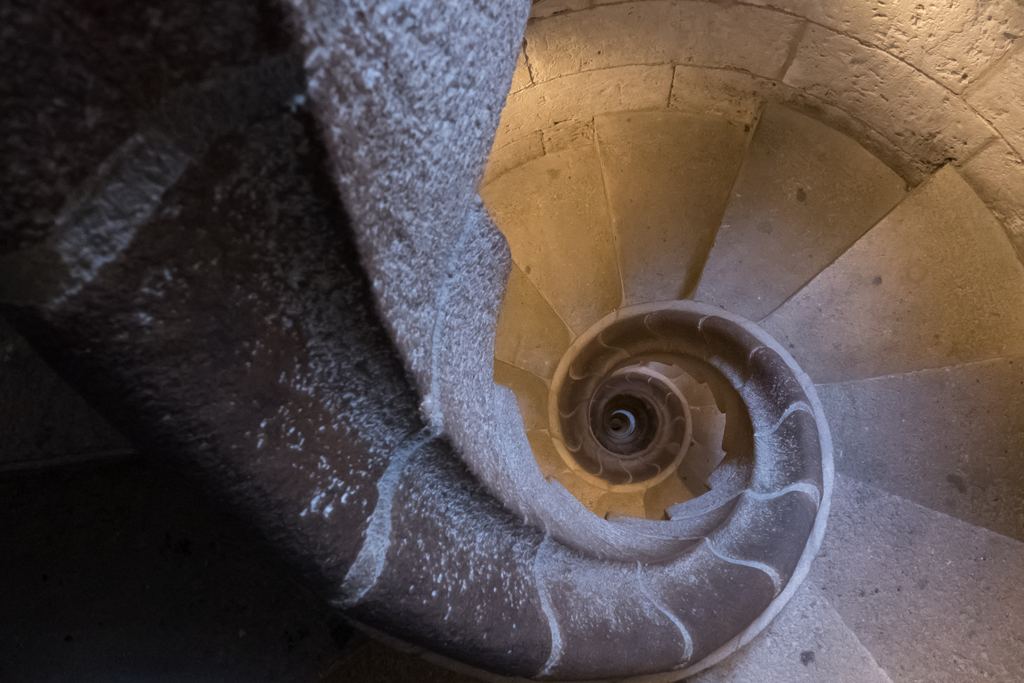
You take the elevator up, but you have to walk down, and that's more important than the view
This is the phrase that should most influence your purchase decision, and the basilica publishes it in three different places: on both entrance tickets and in article 19.1 of the terms and conditions of purchase. It reads as follows: "Access to the towers is by elevator, and descent is on foot."
There is no option to descend by elevator. The descent is via a narrow, winding stone staircase that spirals around itself. For someone with a sensitive knee, a mild case of vertigo, or who is pregnant, this detail completely changes the experience, and it's not mentioned in most resale listings that sell the exact same ticket.
The health conditions that prevent individuals from climbing the towers are listed publicly
This is the section that isn't included in any Spanish guide, and it's hidden in the document that everyone accepts without reading when making a purchase. Article 19.3 of the terms and conditions clearly states who is not allowed to ride for safety reasons:
- Wheelchairs and baby strollers.
- Elderly individuals or people with limited mobility.
- Pregnant women.
- People with vertigo, anemia, a tendency to dizziness, or claustrophobia.
- People with heart conditions, respiratory problems, or other similar ailments.
- Guide dogs and assistance animals.
- Children under 6 years old. Anyone under the age of 16 must be accompanied by an adult.
It's worth noting that the policy regarding service dogs seems to contradict the information provided in the frequently asked questions section. While the FAQs might suggest otherwise, the basilica actually allows service dogs to enter. The animal is permitted inside the temple, but is not allowed to go up the tower.
And there are two loose ends that it's important to know about before you pay.
The first point: "advanced age" has no specific age limit. The regulations do not specify from what age this applies, and at the same time, the official website sells a tower ticket for retired individuals for €28. Both of these things coexist on the same website, and the staff at the entrance decides, which, according to article 19.4, has that authority explicitly.
The second: if access is denied and the ascent is not allowed, you can claim the cost of the tower, but not the cost of the temple entrance or the cost of other services contracted. How much is that amount? The basilica does not break it down at the entrance, but it can be deduced from its own price list: there is a difference of 10 € between a simple entrance and the tower entrance (26 € versus 36 €), and 10 € is exactly what is charged to the companion of a person with a disability for going up. That is the price the establishment charges for the service.
How many steps are there in the descent? No official source provides this information
It's the most frequently asked question about the towers, and there's no official answer. We checked the only way possible: by searching for the words where they should be. As of October 21, 2026, the words "steps" and "rungs" do not appear at all on the pricing page, in the frequently asked questions, in either of the tower access tickets, in the complete terms and conditions, or in the English and Catalan versions of any of these documents.
What's circulating are four different figures, all appearing in advertisements, and none of them match each other.
| Figure | Who publishes it? | What are you talking about? |
|---|---|---|
| 504 | Online travel guides | The descent from the Nativity Tower |
| 427 | Time out | Climbing to the top of the Passion façade |
| Approximately 400 | A travel blog | The entire temple complex, although there is no exact figure available |
| 300 | Visitor guide cards for two operators | The descent, without a specific tower |
Four numbers for the same section of stairs. The honest thing to say is that the figure is not published, and whoever provides it cannot back it up. This includes this website: our own page for the "towers" category says 504, and until the source is shown, it should be read with the same caution as the others.
For those who need to gauge the effort required, there is an official figure that is more useful than a simple count: the basilica estimates the approximate duration of the visit, including the tower, to be one and a half hours, whether guided or not, and classifies the towers as the only area of the temple not suitable for people with limited mobility. If the latter aligns with the condition of the visitor's knees, the exact number of steps becomes less important.
What it costs to go up a tower, with the official price clearly displayed
Climbing the tower costs an additional 10 euros on top of the general admission price. The basilica maintains the same discounts for all four ticket types it offers. These are the official prices, verified directly from the website's code on October 21, 2026, which is the only way to ensure the numbers are accurate and avoid any errors.
| Rate | Basilica only | With tower | Guided tour and tower |
|---|---|---|---|
| General | €26.00 | €36.00 | €40.00 |
| Under 30 years old, or with a student ID | €24.00 | €34.00 | €38.00 |
| Retired | €21.00 | €28.00 | €32.00 |
| Under 11 years old | Free | Free | Free |
| Person with a disability | Free | Free | Free |
| Caregiver for a person with a disability | Free | €10.00 | €14.00 |
Two rows of that table do not appear on any resale websites that we have reviewed.
The discount for those under 30 years old exists; it's two euros less for all options, and you don't need to be a student to request it. And the companion of a person with a disability enters the basilica for free, but pays 10€ if they go up to the tower, which makes sense because the person they are accompanying will not be going up: the towers are the only inaccessible area of the temple. The official website also states this, and it says it like this: "Except for the towers, all areas of the Basilica are accessible."
There are also discounts that are not applied automatically and that are lost if they are not requested in time. Large families and single-parent families receive a 50% discount, as do residents of the city of Barcelona, and unemployed individuals pay €10, but only on Wednesdays from 9:00 AM to 12:00 PM, and only if they provide proof with the DARDE. All three must be requested via email with 48 hours' notice. The "Carnet Jove" discount is the exception: it is applied directly on the form by selecting "Under 30 years old." We compare the four modalities in more detail in our review of the four entrances to the Sagrada Família.
With or without a guide: what's the difference of those 4 euros?
The tower can be added to the basic entrance fee (36 €) or the guided tour (40 €). The difference between those two prices is clearly stated: the guided tour lasts approximately 50 minutes, is offered in various languages depending on the season and time of day, and does not include the museum or the Path of Liturgy, which are visited independently after the tour.
The audio guide, on the other hand, is included in all four options. It is available in 19 languages and in Catalan, Spanish, and international sign language. It has two versions: one of 45 minutes and a shorter, express version of 25 minutes. The basilica also warns that it is not suitable for children under 10 years old. For a family with young children, that statement is more important than the price difference.
If the towers are closed that day, we can recover some money
The towers close, and this isn't a rare occurrence: the regulations stipulate that they must be closed due to bad weather, equipment malfunctions, and maintenance work. There's a discrepancy in the wording between two different sections of the basilica's official documentation, and this difference has financial implications.
The fine print on the ticket states: "The closure of the towers does not entitle you to a refund of the ticket price." Read quickly, and as most people read it, it seems that if the towers are closed, no refund will be given. However, Article 19.2 of the terms and conditions of purchase, which is the agreement you accept when paying, presents it differently:
The towers will remain closed for safety reasons when weather conditions are unfavorable. They will also be closed due to equipment malfunctions, maintenance work, or force majeure events. In these cases, the user will be entitled to a partial refund of the tickets.
The two phrases are compatible if "the entrance fee" is understood as the price of entering the temple, which is never refunded. The part about the tower, however, is refundable. But there's a significant difference between the wording that discourages a refund and the wording that allows it, and it's noteworthy that the discouraging language appears on the page you read before making the purchase, while the language that allows a refund is in the document you accept without even opening it.
To request a refund, there is a deadline: fifteen days from the date of the visit, by mail to the customer service address. When the closure is decided by the organization, the regulations themselves state that the refund is made automatically to the same method of payment. Other terms and conditions for exchanges and refunds, and the schedule for when tickets go on sale, are in the note about the two months' advance notice.
The Christ the Redeemer statue cannot be climbed, and there is no announced date for when climbing might be possible

It's worth mentioning because several promotional materials refer to it, and some even include it in the title. The central tower, the one dedicated to Jesus Christ, is the one that reached 172.5 meters in February 2026, and the one that Pope Leo XIV blessed on June 10th, on the centenary of Gaudí's death. It is not for sale.
As of October 21, 2026, the official website still offers four individual ticket options, and the regulations state that the ticket allows "a visit to one of the two towers": the Nativity Tower and the Passion Tower. There is no third option, and no date has been announced for the introduction of one. Anyone who purchases a ticket believing they will be able to ascend the taller tower will be disappointed.
What the ticket does include, and which the basilica mentions almost in passing, is a virtual visit with augmented reality within the official audio guide, which specifically explores the central towers. This is the alternative available today, and it costs nothing extra. The meaning of each tower and why eighteen are planned is explained on our page about the architecture and symbolism of the Sagrada Família.
Here's what you need to know before you arrive at the door
Here are five things, all from the official website, that have ruined someone's visit each time.
- There is no tolerance for lateness. The frequently asked questions leave no room for interpretation: "Admission is only valid for the selected time slot. If you arrive later than the indicated time, you will not be allowed access." Park Güell, located nearby, allows a grace period of thirty minutes. The Sagrada Família, however, allows none.
- Backpacks and bags are not allowed. There are cloakrooms, but they exist only for that purpose: the website explains that the only lockers in the temple are intended for those who go up to the towers by elevator, and that when you come down, you must retrieve what you stored. There are no cloakrooms of any kind for suitcases.
- Admission is by name. Upon entry, an ID card or passport is required, and the details cannot be modified once the reservation has been made.
- From 9:00 AM to 10:00 AM is the "silent hour," established since February 2, 2026. It can be visited normally, but headphones are mandatory for any audio.
- On Saturdays, it closes earlier. From April to September, the temple is open from 9:00 AM to 8:00 PM from Monday to Friday, and on Saturdays, it closes at 6:00 PM. The same applies in March and October, when it closes at 7:00 PM during the week. This is the detail about the opening hours that is most often misinterpreted.
The complete schedules for each season, including the special holiday hours for Christmas and Epiphany, are on our page for tickets, schedules, and visiting the Sagrada Família, and the rules that most people are unaware of, including the dress code, are on the page tips, rules, and things to avoid.

Frequently Asked Questions about the Sagrada Família Towers
Which tower is better to climb, the Nativity Tower or the Passion Tower?
It depends on the view you're looking for, and that's the only information the basilica provides: the tower of the Nativity facade offers views to the east of the city, while the tower of the Passion facade offers views towards the city center. They cost the same and function identically. Comparisons circulating about which tower has the wider staircase or more light are not supported by any official sources.
Do you use an elevator to get down from the towers?
No. The official website and section 19.1 of the terms and conditions state the same thing: you go up in an elevator, and you come down on foot, using a spiral staircase. There is no option to go down in the elevator.
How many steps are there to go down?
There is no official figure. On October 1, 2026, we checked and found that the words "escalones" (steps) and "peldaños" (steps) do not appear on the pricing page, the frequently asked questions section, the entrance ticket descriptions, or the terms and conditions, in any of the three languages of the website. At least four different figures are circulating on commercial pages: 300, approximately 400, 427, and 504.
Is there a minimum age requirement to go up the towers?
Yes, and it's stated clearly: children under 6 years old are not allowed to enter, and those up to 16 years old must be accompanied by an adult. This is stated in article 19.3 of the terms and conditions of purchase, and it is also repeated on the ticket information.
Can I go up if I have a fear of heights or knee problems?
The regulations explicitly advise against it. Article 19.3 excludes individuals with vertigo, anemia, a tendency to dizziness, claustrophobia, heart or respiratory problems, pregnant women, and elderly or individuals with limited mobility from accessing the towers, for safety reasons. Staff may deny access at the entrance, and in such cases, the cost of the tower can be refunded, but not the cost of the temple entrance.
Can I bring a backpack?
No. Backpacks and bags are left at the cloakroom, which is only available to those who go up to the towers, and they are collected when you come down. There is no cloakroom service for suitcases.
How much does it cost to go up a tower?
The entrance fee with tower access is €36, while the guided tour with tower access costs €40. The same tickets without tower access are priced at €26 and €30, respectively. For individuals under 30 years old and those with a student ID, the prices are €34 and €38; for seniors, the prices are €28 and €32. These are the official prices, as of October 21, 2026.
What happens if the towers are closed on the day of my visit?
The terms of purchase stipulate that access may be closed due to inclement weather, breakdowns, or maintenance, and they recognize the right to a partial refund: the refund covers the cost of the tower ticket only, never the cost of entering the temple. There is a 15-day period from the date of the visit to request a refund. If the closure is decided by the organization, the refund will be automatically processed to the original method of payment.
Is it possible to go up to the Jesucristo Tower, the tallest one?
No. The only two towers currently for sale are the Nativity Tower and the Passion Tower. The Christ the Redeemer tower, which is 172.5 meters tall, is not among the options for purchase, and there is no announced date for when it might become available. The official audio guide includes a virtual tour with augmented reality features for the central towers.
Experiences that include climbing a tower
From the catalog of tower options, sorted by the number of reviews. In all cases, the tower is an add-on to the base unit. It's important to check the details of each option to see if the tower is included or optional, and remember that the specific tower you choose is selected at the time of booking.
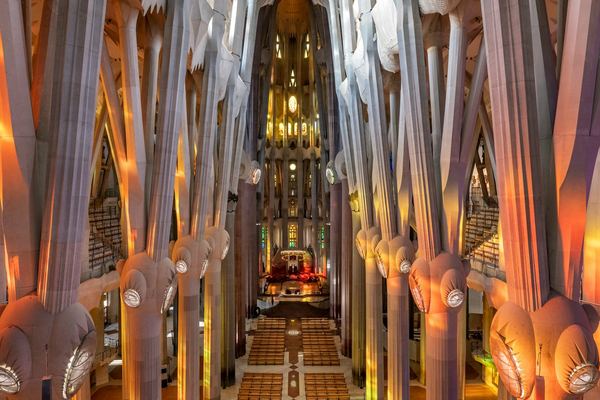
Sagrada Família with quick access and optional tower visit
Direct access to the temple, with its stained-glass windows arranged by color, and the option to take an elevator up to one of the towers.

Sagrada Familia with quick access and the option to ascend the Nativity Tower
Guided tour of the basilica's five levels, with fast-track access, and the option to climb the Passion Tower if selected at the time of booking.

Sagrada Familia visit with a climb to one of the towers, departing from Julià Travel
Check-in at the Julià Travel office at 311 Sardenya Street. After the guided tour, you will be provided with headphones and access to an elevator to visit one of the towers.

Barcelona Pass with access to the Sagrada Familia towers
This pass includes access to the temple towers, as well as Park Güell, and offers several city tour options, all with a single purchase.
Ratings collected by Tiqets, Viator and Tripadvisor
Data verified on. Prices, frequently asked questions, entry tickets, and terms and conditions, all reviewed on sagradafamilia.org on October 21, 2026, and available in Spanish, English, and Catalan. Sobre este sitio


