
The four Sagrada Família tickets, with the official price alongside
The official website sells four types of tickets: €26, €30, €36, and €40. None of them offer "skip-the-line" access, all are named tickets, and latecomers will not be admitted. There is also a discounted rate for those under 30, which is rarely advertised. Prices checked on September 2, 2026.
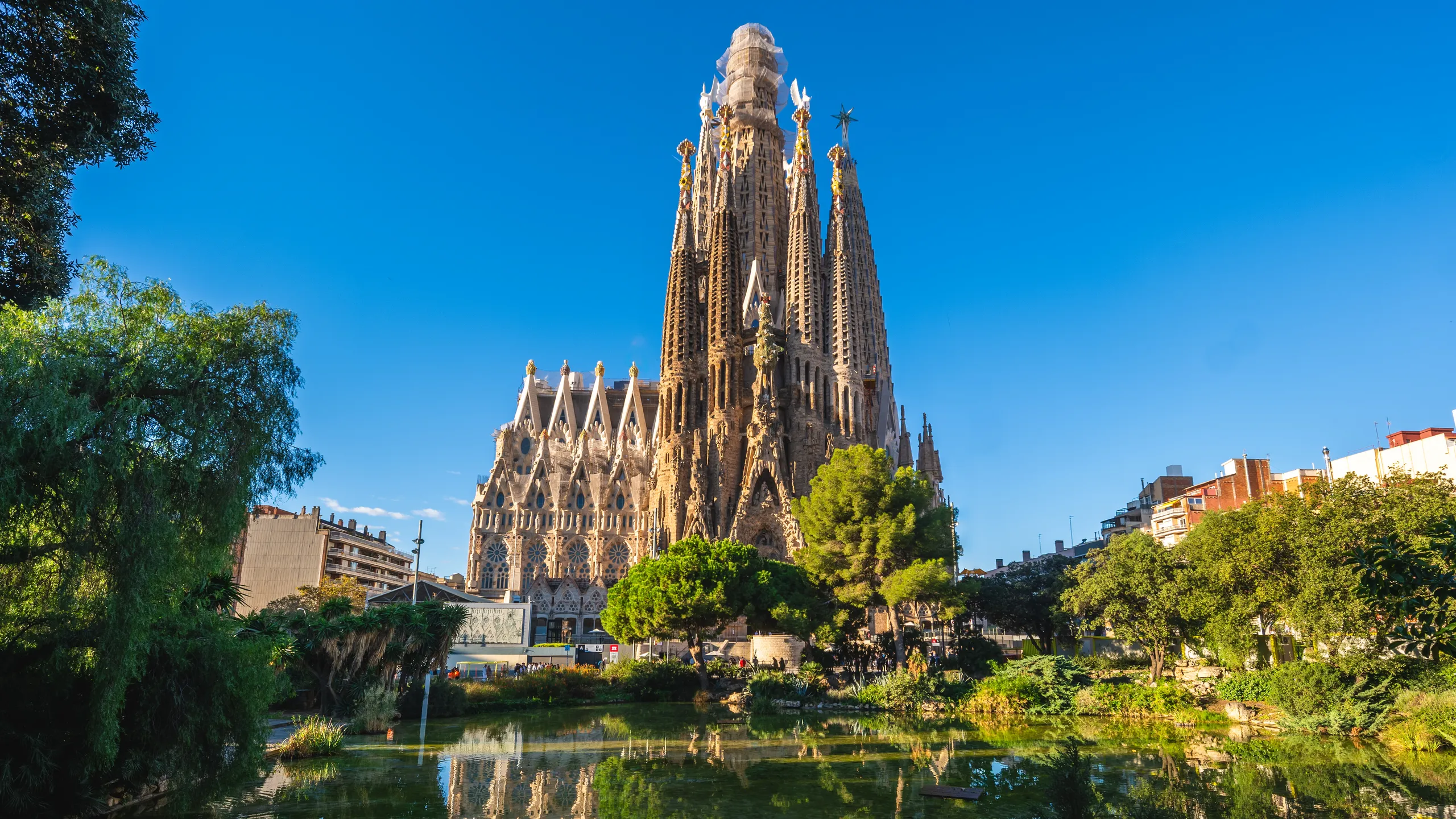
For those visiting on their own, there are four types of tickets for the Sagrada Família. Four, not forty: the basilica publishes them together on the same page, with the price listed next to each one, and without using names of precious metals. They cost 26, 30, 36, and 40 €, and today they still cost that amount.
Any other figure that appears on a screen is that of a reseller. It's worth mentioning this with the official catalog in front of you, because this site also sells: the same basic ticket that the basilica sells for €26 is listed here for €33.80. Below is the table showing the difference and explaining why it exists. This article develops only one row of a broader comparison, that of the eleven ticket offices for Gaudí's works.
The four entrances to the Sagrada Família, with the official price displayed in front of each
The following table is copied directly from the basilica's pricing page, extracted from the page's code on September 2, 2026. Accuracy is paramount: in a previous attempt, using a tool that summarizes instead of reading the code directly, two of these entries were incorrect. An incorrect price bearing our name is precisely what this website criticizes in others.
| Mode | General | Under 30s and students | 65 and over | Companion |
|---|---|---|---|---|
| Sagrada Familia with audio guide | €26 | €24 | €21 | 0 € |
| With guided tour | €30 | €28 | €23 | 4 € |
| With access to a tower | €36 | €34 | €28 | 10 € |
| With guided tour and tower access | €40 | €38 | €32 | €14 |
The last column requires a clarifying note because it's the most confusing part of the table. People with disabilities have free entry to the basilica and only pay for any additional services they use, so their box shows zero for all four options. The person accompanying them pays for those services: nothing for entry, €4 if there's a guided tour, €10 if there's a tower visit, and €14 if there's both. It's important to know this before buying two tickets.
Overall, the table has a consistency that no guide mentions. The difference between the basic ticket and the guided tour is 4 €. From either of those options to their version with the tower, it's 10 €, the same ten euros for both combinations. And the reduced prices aren't the same: those under 30 and students save a fixed amount of 2 € in all four options, while the discount for those over 65 increases with the ticket price, from 5 € for the basic ticket to 8 € for the tower options. Someone who is 28 years old saves the same amount whether they buy the cheapest ticket or the most expensive one. Someone who is 70, does not.
Price of admission to the Sagrada Familia: what is included in each ticket type
Here, the table is no longer sufficient because the four options are not the same visit with additional features added on.
The 26 € ticket provides access to the basilica and the museum, with no time limit, and includes the audio guide through the official application. It is available in 19 languages, plus signage in Catalan, Spanish, and international sign language, and has two versions: 45 minutes for the standard version and 25 minutes for the express version. It is not suitable for children under 10 years old. It does not include access to the towers or the crypt. The basilica estimates a one-hour visit.
The option for 30 € includes a guided tour of the house for approximately 50 minutes. And here's the key piece of information that changes the decision: the guided tour does not include the museum or the liturgical tour. The website itself states this, adding that these can be visited independently after the tour. The 4 € difference doesn't buy more of the building; it buys a person instead of an app for fifty minutes, and leaves the museum as it was.
It's worth reading the descriptions carefully twice before booking for a group. If you're looking for someone to explain the museum and the models, neither of the ticket options includes that.


Birth or Passion: The tower is chosen at the time of purchase
The two ticket options with tower access, priced at €36 and €40, allow access to one tower, not both, and the tower is chosen at the time of purchase. The "Nativity" tower overlooks the east of Barcelona; the "Passion" tower overlooks the city center. The visit duration has increased from one hour to one and a half hours.
Two conditions that are worth knowing before paying. You go up in an elevator, and you come down on foot. Also, the tower is the only part of the basilica that is not accessible to people with limited mobility. Furthermore, bags and backpacks are not allowed at the top: there are lockers, but only for the duration of the ascent.
The number of steps leading down is another story. There are four different figures circulating online, and the basilica doesn't publish any, so I won't be providing a number here either.
The discount for those under 30, which almost no guide mentions
In the official table, there is a row that rarely appears in the rest of the sector: people under 30 years old, with the same rate as students. The prices are €24 instead of €26, €28 instead of €30, €34 instead of €36, and €38 instead of €40. In the review of fourteen guides and business directories that we conducted in August 2026, none of them mentioned this.
Two euros won't change a trip. What's striking is that a fee published directly by the monument itself, available year-round and without any seasonal restrictions, doesn't even make it onto the websites that people read before making a purchase.
With one caveat that the official website doesn't fully explain. The fare is listed in the reduced fare table, and below it states that any reduced fare must be verified at the gate. However, further down, among the special discounts, there is a section called "Pack Jove" which explains how it is applied automatically: you choose the under 30 option when purchasing, select "Carnet Jove" and enter the document number. The page does not clarify whether the "Carnet Jove" is mandatory or just a quick way to apply the discount. Until it clarifies this, it is advisable to bring your identification document and, if you have it, the "Carnet Jove" card.
The basilica sells that ticket for €26. This website, however, sells the same ticket for €33.80. It's much easier to write about it than to let someone discover that after they've already paid.
The discounts that are not listed in the first table
Below the reduced prices, the official website has a second list, shorter and quite unusual. Large families and single-parent families receive a 50% discount, and residents of Barcelona have their own promotion, also at 50%. Neither of these applies on its own: you must request them by mail with at least 48 hours' notice and with proof, and the resident discount also has a condition that it is advisable to read, because it does not accumulate with any other discount.
The rest of the list consists of individual cases, and one of them is the narrowest street in Barcelona.
- People who are unemployed pay less, only on Wednesdays, from 9:00 AM to 12:00 PM, by presenting a valid DARDO.
- The "Ruta del Modernisme" vouchers are discounted by 1 euro.
- ICOM and press credentials are also listed, but no fees are specified.
- Religious individuals should enter through access point D, and must present their credentials.
Two of these discounts require you to send an email two days in advance, and another one is only valid for three hours a week. If someone decides on Friday that they're going to the basilica on Sunday, these discounts won't be enough.
What costs the same, what costs more, and why
This website generates revenue by selling tickets through affiliated platforms, so the comparison that follows is inherently biased. However, it's still valuable because it's the only way to give meaning to the figures presented.
| What's purchased | Official rate | In this catalog | Difference |
|---|---|---|---|
| Admission includes an audio guide, but does not include access to the tower | €26 | €33.80 | €7.80 more, a 30% increase |
| Guided tour, approximately 50 minutes long | €30 | From €45 | Not comparable: own guide and other conditions |
| Entrance with access to a tower | €36 | No individual tickets available: access to the tower is only through guided tours | Not comparable |
The first row is a straightforward comparison because the product is identical. The supplier's listing includes entry with fast track access and an application with a downloadable audio guide, and excludes the tower. That is, point by point, the €26 entry for the basilica. The 7.80 € difference is the intermediary's markup, 30% above the official price. They are all in the category of tickets and fast track access, with the official price listed next to each one.
The second option is not comparable, and it's important to understand that. A guided tour for €45 is not the same as the €30 option with an added fee. The €45 tour includes its own guide, a meeting point outside the temple, often headsets for the group, and different cancellation policies. It may or may not be worth the extra cost, but it's a different product altogether, even with a different price.
When does it make sense to pay for a premium option? When the desired time slot is no longer available on the official website, which often sells out days in advance during peak season. When you want more flexibility to cancel than what the basilica offers, which requires 48 hours' notice. When you're looking for a tour in a specific language at a specific time, something that the standard tour doesn't guarantee, as the language of the guided tour depends on the season and the time slot. And when the premium package also includes transportation, a visit to another monument, or a transportation pass.
When is it not worth it? When there is official availability for the desired day, and nothing else is required. In that case, it costs €26, and that's it.
Rules that ruin a visit
Half of the complaints at the checkout counter don't stem from the price, but rather from five lines of terms and conditions that almost no one reads.
- The entry is nominative, personal, and non-transferable, and the data cannot be changed once the reservation has been made. At the entrance, you must show an official document with a photo.
- Those who arrive late will not be admitted. The official FAQs are literal: admission is only valid for the chosen time. There is no published grace period, unlike at Park Güell, which allows a thirty-minute window.
- Returns and exchanges are generally not possible. They must be requested at least 48 hours in advance; within 48 hours, an official justification is required; the exchange must be made within 15 days following the scheduled date and is subject to availability.
- Under 16 years old, accompanied by an adult. Children under 11 enter for free, and children under 3 do not need a ticket: these are two different age limits, and the second one is almost never publicized.
- Groups are not allowed to enter with individual tickets.
In addition to this, there are security checks with metal detectors, a ban on bringing in food and drinks, a dress code similar to that of an active church (nothing transparent, pants and skirts below the mid-thigh, no swimwear, shoulders covered in the chapel of the Blessed Sacrament), and a recent rule: since February 2, 2026, the first hour of the day, from 9:00 AM to 10:00 AM, is a time of silence. It can be visited normally, but any audio requires headphones. Those who book the 9:00 AM slot should be aware of this before arriving.
The schedule has a catch on Saturdays
The basilica's opening hours change three times a year: from November to February, it's open from 9:00 AM to 6:00 PM; in March and October, it's open until 7:00 PM; and from April to September, it's open until 8:00 PM. On Sundays, it opens later, at 10:30 AM.
What almost no one realizes is that on Saturdays, this rule does not apply. In March and October, and also from April to September, on Saturdays, it closes at 6:00 PM, while on weekdays, it stays open until 7:00 PM or 8:00 PM. In the middle of August, on a Friday, it has two more hours of opening hours than the following Saturday. And on December 25th and 26th, and on January 1st and 6th, the hours are reduced to 9:00 AM - 2:00 PM. The complete details, including transportation and access, can be found on the ticket, hours, and visit page, and the entire building is described in the Sagrada Família information page.


Frequently asked questions
Are there any tickets available for the Sagrada Familia that allow you to skip the lines?
These are not sold as a separate product. All tickets are for a specific time slot, and the basilica itself states that with a ticket purchased in advance, you can enter without waiting. When a website advertises "skip-the-line" or "fast access," it is simply selling the regular ticket under a different name.
Can I buy the ticket at the box office?
There is no ticket office. The official website states on two separate pages that tickets are only sold online. However, the frequently asked questions section mentions that there are QR codes for direct purchase located around the temple, with availability depending on what's currently available. Both statements appear on the same official website and don's directly contradict each other: the QR code leads to the same online store, allowing you to purchase tickets while standing on the street, but without any guarantee of availability.
Is the ticket assigned to a specific person?
Yes. The ticket is nominative, personal, and non-transferable. You must provide your personal details when purchasing it, and these details cannot be changed afterward. Furthermore, you must present an official photo ID at the entrance. If you purchased a discounted fare, you must also bring the document that proves your eligibility for the discount.
What happens if I arrive late for my scheduled time slot?
Entry is not permitted outside of the designated time slot. The official FAQs state this clearly: entry is only valid for the time you have booked. There is no published grace period, so it's advisable to factor in the time required for security checks, which are mandatory for everyone.
Can a ticket be returned or exchanged?
Generally, we do not accept changes or refunds. Requests must be made at least 48 hours in advance; within that timeframe, official documentation is required to explain why the change is necessary. Only unused tickets are eligible for refunds or exchanges. Exchanges must be made within 15 days of the original date, and are subject to availability.
Do children have to pay for admission?
Children under 11 years old are admitted free of charge for all four activities, although they still need a free ticket. Children under 3 years old do not require a ticket. Children under 16 must be accompanied by an adult. Furthermore, the audio guide on the app is not suitable for children under 10, which is a good reason to consider a visit specifically designed for families.
When do the tickets go on sale?
The basilica states that tickets can be purchased approximately two months in advance of the visit. This is a rolling timeframe, not a fixed date: each month, tickets are released for the month that is two months ahead.
Are you planning to see more than one of Gaudí's works?
The page for combined tickets compares which combinations actually save you money, and which ones don't save anything at all.
The entries that this article discusses
The prices listed above are for the basilica models. These are the models we sell here, and their prices are clearly displayed.

Combined tickets: Sagrada Familia, Park Güell, Casa Batlló, and La Pedrera
Enjoy access to all four attractions with a single ticket, including an audio guide in Spanish, and explore at your own pace: no group schedules and no need to purchase four separate tickets.

4-hour private tour: From the Sagrada Familia to the Roman necropolis of La Vila de Madrid
A four-hour private tour, including metro transportation, from Passeig de Gràcia to the Temple of Augustus and the Roman burial road in the Vila de Madrid area.

90-minute private photoshoot: Sagrada Familia, Park Güell, and Gothic Quarter
One and a half hours with a professional photographer at the Sagrada Familia and in less crowded areas, with over 40 high-resolution photos and a private online gallery.

Afternoon tour of the Sagrada Familia for a group of 6, with a terrace for taking photos
The tour starts at Plaça de Gaudí, with a stop at a little-known terrace for photographing the facade, and includes skip-the-line access to enjoy the afternoon light.
Ratings collected by Viator and Tripadvisor
Data verified on. Prices, schedules, and conditions as listed on the official website of the basilica on September 2, 2026. Resale prices are from our own catalog, also on the same date. Sobre este sitio


