

The first house designed by Gaudí, and the last one that could be entered
Ten dishes starting from €20, 4,002 reviews, and an official price that the restaurant doesn't publish anywhere.
On this page, there are ten listings for Casa Vicens. The cheapest one costs 20 €, and the most expensive one costs 304 €, although the latter is a private offering that also includes access to two other attractions. Together, they total 4,002 reviews. One piece of information is missing, and it's the most important one: the official price of the house. Casa Vicens does not publish this on its website in any place that can be read, copied, or cited; it's hidden within a widget that only opens after you've started making a purchase. We checked this on August 25, 2026. So, this page does the only honest thing that remains: it lists what each seller charges, along with the date, and explains why the same ticket appears at 20 €, 21 €, and 24 €.
The ten options are not ten distinct visits. Four of them are the same general admission with a reserved time slot, and the only difference between them is who is selling the ticket, whether it includes an audio guide, and the commission they retain. The other six options are different: one is a guided tour, another includes breakfast in the garden café, and the remaining four are tours that combine a visit to Casa Vicens with other works by Gaudí. If you arrived looking specifically for "Casa Vicens tickets," the actual price difference is only four euros, as shown in the table below.
Casa Vicens with a guide: Gaudí before he became Gaudí
A guided tour of the house where Gaudí made his name, a place where he had already experimented with almost everything he would later become famous for.
Casa Vicens: Experience Catalan Modernism without the queues
This building represents the architect's first major commission, now a museum, and showcases the ceramics and geometric designs that he would later incorporate into all of his work.

Casa Vicens: Skip the lines and enjoy an audio guide tour of Gaudí's first house
The first work by Gaudí, located in the Gràcia neighborhood and outside the usual tourist circuit, offers direct access, an audio guide, and staff on each floor to answer your questions.

Casa Vicens, with breakfast or vermouth served in the café's garden
Visit Gaudí's first house, and enjoy a complimentary beverage at the garden café: choose from a sweet breakfast, vermouth with olives, or mango ice cream.

Pass for three Gaudí houses: Batlló, Milà, and Vicens
With just one tap on your mobile device, you can access information about all three buildings, which, when viewed in order, reveal how Gaudí's style evolved over thirty years of work.

Privately commissioned by Gaudí, these buildings share a connection to the hospital where he died: a look inside La Pedrera and Casa Vicens
A three-hour tour that takes you from the Palau Güell to the hospital where the architect died, with skip-the-line access and audio guides available at both La Pedrera and Casa Vicens.

The Gaudí that you won't find on postcards: Colònia Güell, Bellesguard, and Casa Vicens
Explore six lesser-known Gaudí masterpieces, including the crypt that served as a testing ground for the Sagrada Família, and enjoy a tapas meal in the neighborhood.

Three houses designed by Gaudí: Casa Vicens, La Pedrera, and Casa Batlló
Three hours with guaranteed entry to the interiors of all three houses, starting with Casa Vicens, which is rarely included in Gaudí tours.

Casa Vicens: Valid entry for six months
Gaudí's first major commission, featuring a garden dedicated to Saint Rita, a rooftop, and the Catalan vaults of the La Capell workshop. No completion date has been set.

Entrance to Casa Vicens with an audio guide available in 13 languages
Self-guided tour of Gaudí's Mudéjar-style summer house on Carrer de les Carolines, with the option to add an ice cream at the café.
Ratings collected by Tiqets, Viator, Tripadvisor and Civitatis
Four identical items, but three different prices
The general admission to Casa Vicens is sold here at 20 €, at 21 €, and at 24 €. These are three prices for the same thing: entering freely, with a reserved time slot. There's a difference of four euros, a 20%, between the cheapest and the most expensive option, and they don't offer anything different.
What's striking isn't the markup, which exists everywhere. It's the fact that there's no official price here against which to measure it. We can say that for the Sagrada Família, a reseller charges 30% more, since the basilica publishes its official price of €26. For Park Güell, it's 19% more than the official price of €18. We can't say anything about Casa Vicens, and that's where the six figures circulating online come from: €16, €18, €20, €21, €22, and €24. The only two websites we found that are updated to 2026 contradict each other.
| Product | Seller | Price | What's included | Reviews and rating |
|---|---|---|---|---|
| Casa Vicens | Tiqets | €20 | Entry with a reserved time slot. Starting from €23 | 247 · 4.6 |
| Entrance to Casa Vicens | Civitatis | €21 | Reserved time slot | 204 · 4.6 |
| Casa Vicens: No waiting in line to enter | Tiqets | €24 | Reserved time slot | 1.688 x 4.7 |
| Skip-the-line entry with audio guide | Viator | €24 | Admission and audio guide | 716 · 4.7 |
| Casa Vicens by Gaudí: Guided tour | Tiqets | €24 | Live entry and guide | 226 · 4.8 |
| Sweet Gaudí | Viator | €26 | Admission and either breakfast or a snack in the café | 98 x 4.7 |
| 3 Gaudí Houses | Tiqets | €95.50 | Vicens, Batlló, and Milà, with the three entrances | 644 · 4.7 |
| Tour of Gaudí's Houses | Viator | €119 | Three-hour guided tour: Vicens, Pedrera, and Batlló | 152 · 4.8 |
| Private tour: La Pedrera and Casa Vicens | Viator | €156 | Exclusive guide for your group | 24 x 4.7 |
| Less well-known works by Gaudí | Viator | €304 | Private: Colonia Güell, Casa Vicens, and Bellesguard | 3 x 4.7 |

What's inside
One hour, and a dining room painted from floor to ceiling
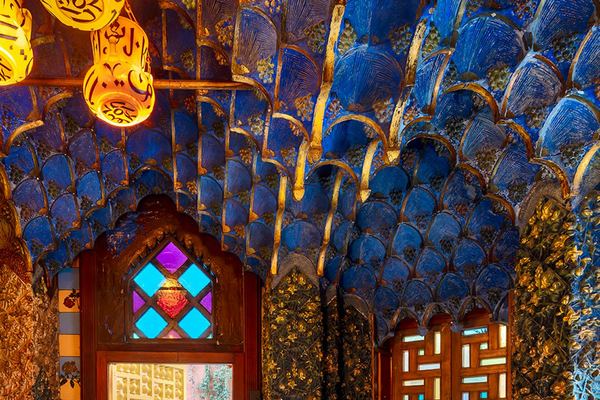
Casa Vicens is a small house, and it's important to be aware of this before you pay. The main floor, which Gaudí decorated entirely, features the dining room with its beams covered in leaves, the walls painted with ivy, and four panels by Francesc Torrescassana inlaid in the wood. Next to it is the smoking room, with its ceiling made of stucco in a Moorish style.
The rest of the tour consists of the rooms in the 1925 extension and a permanent exhibition about the house and about Gaudí. You can see the entire house in just over an hour. If you're coming from Casa Batlló, be prepared for a different experience: here, there's no spectacle, just a house.
A summer house in a town that no longer exists
When Gaudí built it, the street where it stands, Carrer de les Carolines, was not yet in Barcelona. Gràcia was an independent municipality, with its own town hall and its own festivals, and it wasn't incorporated into the city until 1897. Manel Vicens i Montaner, a stockbroker, wanted a summer house outside the city, and he got it: at that time, that area was still countryside.
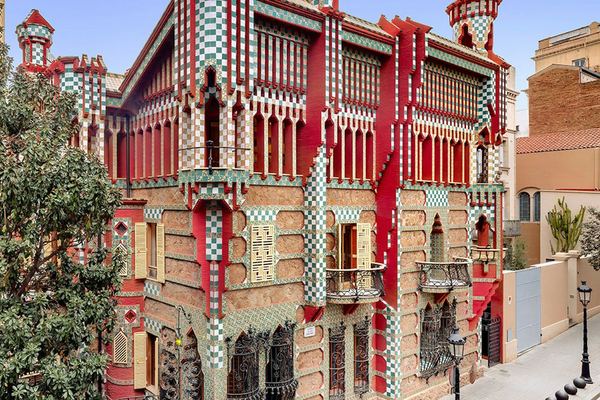
It's worth knowing this because it changes what you expect when you arrive. Casa Vicens is not a grand apartment in the Eixample district, like Casa Batlló, nor is it a rental building like La Pedrera. It's a standalone house with a garden, now situated between apartment buildings on a narrow street where it's impossible to stand back far enough to see the entire facade. The best view of the facade is from the street across, and even then, you have to look up quite a bit.
By the way, this clears up a misunderstanding that has persisted for decades. Vicens is often presented as a tile manufacturer, which is where the ceramic facade supposedly comes from. However, the museum itself refutes this: he was a stockbroker and currency trader. The green and white checkered pattern is not an advertisement for anyone.
From private home to museum
Here are six reasons why this house is missing from almost all printed guidebooks.
The origins
1883-1885
The first major project
At the age of thirty-one, and with five years of professional experience, Gaudí designed and built a summer house for Manel Vicens i Montaner on a plot of land in Gràcia. This was his first major project.
The growth
1925
The house is expanding, while the garden is shrinking
Joan Baptista Serra Martínez expanded the building, maintaining Gaudí's architectural style. The land was reshaped, and a portion of the original fence was dismantled.
2005
It has been added to the UNESCO list
The expansion of the "Works of Antoni Gaudí" site now includes Casa Vicens, which has been added to the properties already inscribed since 1984.
2014
Purchase from a bank
MoraBanc acquired the building, which had previously always been a private residence, and financed the restoration work that made it possible to open it to the public.
Today
November 16, 2017
Opens as a museum home
It's the last of Gaudí's major works in Barcelona that can still be visited, and the reason it's often missing from printed guidebooks that are still circulating.
2026
The centennial celebration has come and gone
None of the Spanish publishing houses we reviewed mention the Casa Vicens in connection with the centenary of Gaudí's death. The house itself does not mention it on its website either.

A detail that's free to see
The palm leaf fence that ended up in Park Güell
Gaudí enclosed the garden with a wrought iron fence shaped like palm leaves, repeated to cover the entire fence. When the land was reshaped in 1925 to expand the house, part of this fence was dismantled, and its palm leaves ended up closing one of the entrances to Park Güell. They are still there, and it's free to see them.
The other botanical detail is on the facade and is also visible from the street: the carnation tiles, featuring the yellow and orange flower that grew on the very site, which Gaudí incorporated into the ceramic work instead of inventing a new design.
What you can see from the sidewalk, without paying
The facade is half of the building and faces the street. It's worth taking a few minutes to admire it before entering, or even instead of going inside if the weather is nice.
First, there's the checkerboard pattern. Gaudí alternates green and white tiles in squares, and the rhythm changes as you go up: at the bottom, stone and brick dominate, while above, ceramics are used, making the building appear lighter than it actually is. Second, there are the bands of jasmine, the flower that used to grow on the site. And third, the iron and wood balconies: in 1885, they weren't just decorative; they were a way to create an open space without expanding the building's footprint.
A helpful tip: The street, Carrer de les Carolines, is narrow and there's nowhere to stand to get a full group photo. The only position that works is on the sidewalk across the street, right up against the wall, and even then, a vertical phone shot won't capture everyone. A horizontal shot is impossible.
The schedule is also not where it should be
The same thing happens with the opening hours as with the price: the company's website includes this information within the purchasing process, so there's no single, reliable source to cite. And the websites that copy this information don's agree with each other. One of the most prominent ones states in the main body of the article that they are open every day from 10:00 AM to 8:00 PM, and a few paragraphs later, in their own FAQ section, that they are open from Tuesday to Sunday from 10:00 AM to 5:30 PM. Both statements cannot be true.
The recommendation is a bit boring, but it's the only one that really matters: the time slot is assigned to you during the booking process on the day you reserve, and that's the important part. If you can choose, opt for a morning slot during the week. Not because of queues, as there aren't any here, but because the house is small, and a group of twenty people will definitely make it feel crowded.
It's the only work by Gaudí in Barcelona whose official price cannot be seen without actually starting to purchase it.

How to find a part-time job in the Gràcia neighborhood
Casa Vicens isn't a place you can spend an entire day in, and that's perfectly fine: it's best enjoyed for about an hour, with the rest of the neighborhood explored around it. From the entrance, the Plaça de la Vila de Gràcia and the Plaça del Sol are just a ten-minute walk away, and these are the places to eat in Gràcia without ending up in a tourist trap.
If your day includes Park Güell, the best approach is this: start with Casa Vicens first thing in the morning, have lunch in the Gràcia neighborhood, and then head up to the park in the afternoon. Fontana and Lesseps are consecutive stops on line 3, so the journey takes about four minutes plus the uphill walk. The reverse order is less ideal: you'll be tired after visiting the park, and a small, detail-rich house like Casa Vicens is difficult to appreciate when your legs are aching.
Just a final note regarding timing. The peak period for searches about Gaudí in Spain is April, while the lowest periods are July and August: people tend to research this three or four months before traveling. If you're planning a trip for Easter week in January, this is the ideal time to book tickets for Casa Vicens, as they are still available, while tickets for the Sagrada Família are already sold out.
Which of the ten would I buy?
The one for 24 € includes a live guide, and I'm not just saying that: it costs exactly the same as the best-selling "skip-the-line" ticket, and it has a better rating, 4.8 compared to 4.7, based on 226 reviews. For the same price, someone will tell you about the place.
If the idea is to spend little, the 20 € option from Tiqets is the cheapest we've found, and it's currently listed at 23 €. It's the same ticket as the 24 € one. The 21 € option from Civitatis is in the middle and doesn't offer anything that the others don't.
There's a third option that almost no one considers. For 26 €, which is six euros more than the minimum, you can enter and have breakfast in the cafeteria, which is located in the back garden. It's one of the few terraces in Gràcia where you can admire a Gaudí facade without anyone pushing you. With 98 reviews and a rating of 4.7, it's not a completely blind gamble either.
The four itineraries that connect Casa Vicens with other works are a separate option, not this one. If you want to visit three houses in a day, the €95.50 package works out to about €32 per house. The private tour, priced at €304, has only three reviews, and it's still too early to draw any firm conclusions based on such a small sample size.
FAQ
What is the actual cost of admission to Casa Vicens?
Does the guided tour offer enough value to justify the cost if it's the same price as a regular ticket that allows you to skip the line?
Why does the most expensive ticket cost four euros more than the cheapest one?
How long does the visit last, and what can you see?
Is it worth visiting if I've already seen Casa Batlló and La Pedrera?
How do you get there, and is it necessary to make a reservation?
And what about the company that actually publishes its prices?
The Casa Batlló is the only one of the eight works that publishes its ticket prices and even provides a list of authorized resellers. Here's a comparison of the entry prices.
Data verified on. Prices and reviews: catalogs from Tiqets, Viator, and Civitatis, accessed on August 25, 2026. On the same day, we also verified that Casa Vicens does not publish its prices or opening hours in HTML format.