
The stained glass windows have a schedule: find out what time each color appears in the Sagrada Familia
The basilica explains on its blog how its stained glass windows work, but almost no one mentions it. We compared this information with the official schedule and the hours of sunlight: the sunrise it describes always occurs when the temple is closed, and the sunset is only visible for three months of the year.
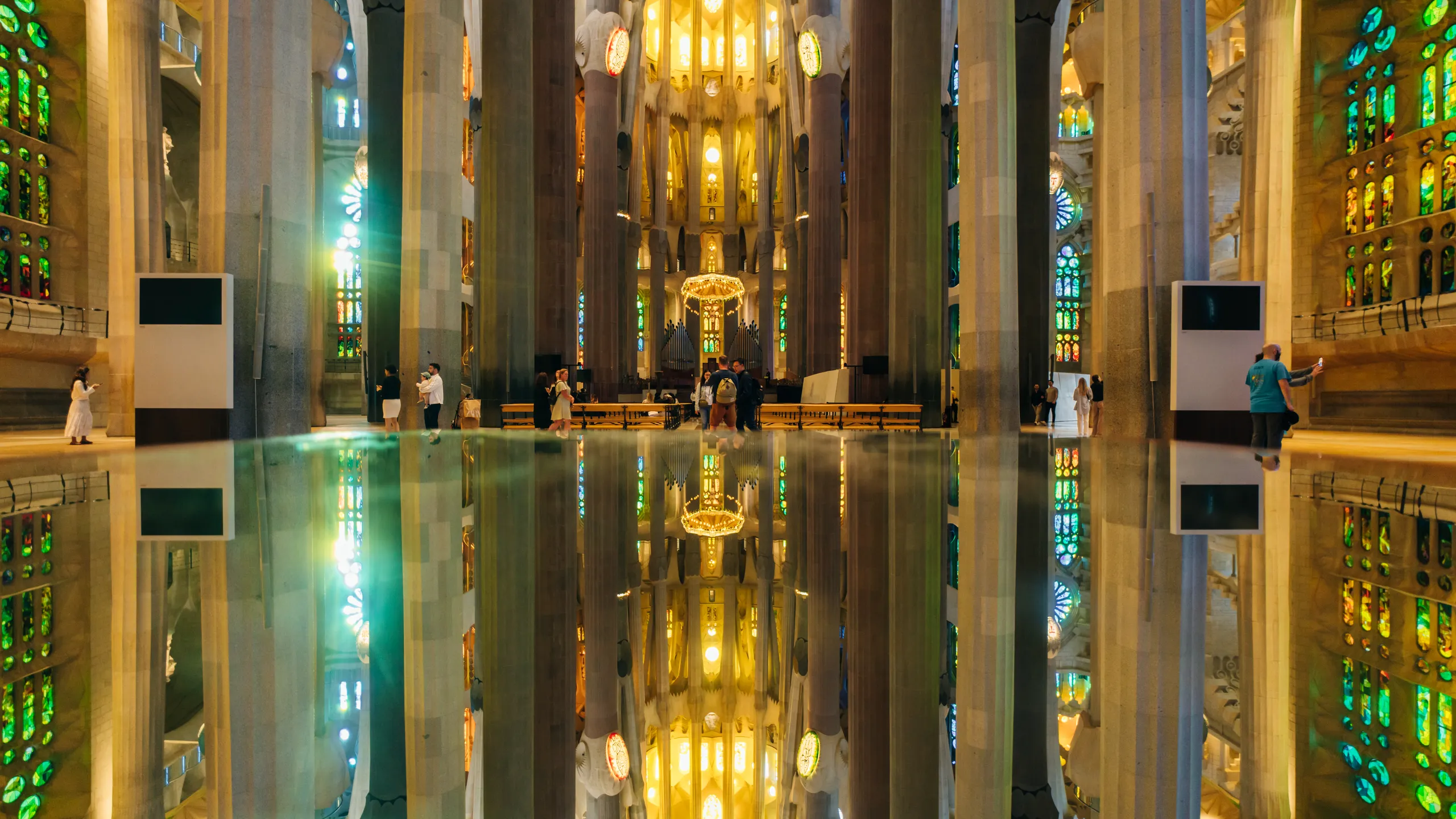
The question is frequently asked on Spanish-language travel forums, and almost no one answers it with a specific time: "What time is the best time to enter the Sagrada Familia to see the stained glass windows?" The two common responses are "in the morning" and "look at photos and decide." Neither of these is helpful for choosing a time slot when purchasing tickets, which is what you really need to do.
The basilica has explained this. It's on its own blog, in an article signed by Joan Tomàs and published on 18 de junio de 2025, which explains the purpose of each color and why it is located where it is. It is an official source, it is free, and almost no one cites it.
What follows combines this text with three other pages from sagradafamilia.org: the schedule, the regulations, and the frequently asked questions, all reviewed in their entirety on October 28, 2026, and with the sunrise and sunset times calculated for the temple's coordinates. From this combination, something unexpected emerges: the moment that the basilica itself describes as the most intense of the year occurs with the doors closed.
Gaudí used color in the lower parts of his buildings, unlike the Gothic style
In a Gothic cathedral, the colors are most vibrant at the top. This makes sense: the light reaches directly there, unobstructed by trees or buildings, while below, where the light is already filtered by the street, the glass becomes lighter. The Sagrada Familia does the opposite, and this is a deliberate choice by Gaudí, not a mere coincidence of the design.
Below, at eye level, are the stained-glass windows with vibrant colors, featuring the names of saints and sanctuaries written so they can be read. Above, in the tall windows, there is neither polychromy nor inscriptions: just clear glass, allowing the sunlight to illuminate the mosaic vaults and emphasize the height of the space. Gaudí himself mentioned this in conversations recorded by the architect César Martinell.
At the Sagrada Familia, we will only apply color to the lower sections and those areas that are not exposed to direct sunlight. The upper sections will, of course, be colored, as the sun is a great artist that paints with beautiful colors in our region.
Isidre Puig Boada, an architect and disciple of Gaudí, wrote it down in 1929, three years after the master's death, in a book that would serve to document how the temple should be: the lower windows with intense colors, the upper ones with white light, and the latter with a single purpose, to illuminate the vaults.
There's a detail that's missed if you only look at the color. The white panes at the top aren't flat. They have irregular thicknesses and different textures, and that irregularity breaks down the white light into the entire spectrum it contains. Below, the color is determined by the glass. Above, it's determined by the thickness.
Blues to the east, reds to the west

The side representing the Nativity takes the cold
The morning sun streams in from the east, where the facade depicting the Nativity is located – the beginning of life in the story that the building tells. That's why the windows on that side have a bluish, cool tint, like the light of dawn.
As the afternoon sun sets in the west, where the Façade of the Passion is located, marking the end of the day and of life, the stained glass windows glow with red and orange hues. According to the basilica, Gaudí uses light and color to depict the birth and death of Jesus.
It's worth mentioning who created them, as they are often attributed to Gaudí with great enthusiasm. The stained glass windows in the nave were created by Joan Vila-Grau (Barcelona, 1932-2022), who began work in 1999 and worked on them for more than twenty years. Vila-Grau considered himself a painter before a stained glass artist, and he abandoned the traditional iconographic program to create what critics have called a program of color.
He also didn't use the technique that Gaudí had developed. Gaudí experimented with trichromy during the restoration of the Cathedral of Palma de Mallorca, layering primary-colored glass and then etching it with acid to achieve the precise shade. Vila-Grau, on the other hand, worked with stained glass, which fits the pieces into an H-shaped lead framework. The lead not only holds the pieces together but also defines the rhythm of the design, which is particularly noticeable in the white stained glass panels at the top, where there is no color to distract the eye.
The sunrise that the basilica describes occurs with the doors closed
Here's the part we haven't read anywhere else. The basilica explains that the spectacle intensifies around the two solstices, June 20th and 21st, and December 21st and 22nd, because at those times, the sun's rays strike the stained-glass windows almost perpendicularly. In the summer, the sun rises further east and enters straight through the side depicting the Nativity; in the winter, it sets earlier, before reaching the west, and enters straight through the side depicting the Passion. According to the article, at sunrise and sunset, each rose window projects its light onto the column and the vault module directly in front of it.
The problem is the time. The temple opens at 9:00 from Monday to Saturday and at 10:30 on Sundays. And in Barcelona, the sun never rises later than 8:20, not even on the latest day of the year. In other words: there isn't a single day out of the 365 in which the doors open before sunrise. On June 15th, the sun rises at 6:17, and you have to wait two hours and forty-three minutes for them to open. That low ray of the summer solstice, the one that enters perpendicularly through the blues of the Nativity scene, is seen by the pigeons.
What you can see is a low morning sun, and that depends on the month. At 9:00 AM, with the temple newly opened, the sun is 6.3 degrees above the horizon on January 15th, and 27.6 degrees on June 15th. More than four times higher. If what you're looking for is the grazing light on the blue side, the month is more important than the hour, and the month is January.
| Month | The sun is rising | Sun elevation at 9:00 AM | Sunset | Closed (Mon-Fri) | Can you be inside when it sets? |
|---|---|---|---|---|---|
| January | 8:15 AM | 6.3° | 5:45 PM | 6:00 PM | Yes |
| February | 7:47 AM | 11.8° | 6:24 PM | 6:00 PM | No, for 24 minutes |
| March | 7:04 AM | 20.4° | 6:57 PM | 7:00 PM | Yes, for 3 minutes |
| April | 7:13 AM | 19.2° | 8:30 PM | 8:00 PM | No |
| May | 06:33 AM | 25.7° | 9:02 PM | 8:00 PM | No |
| June | 06:17 AM | 27.6° | 9:26 PM | 8:00 PM | No |
| July | 6:30 AM | 25.6° | 9:24 PM | 8:00 PM | No |
| August | 7:00 AM | 21.2° | 20:52 | 8:00 PM | No |
| September | 7:31 AM | 15.7° | 20:03 | 8:00 PM | No, for 3 minutes |
| October | 8:02 AM | 9.5° | 7:12 PM | 7:00 PM | No, for 12 minutes |
| November | 7:39 AM | 12.1° | 5:33 PM | 6:00 PM | Yes |
| December | 8:10 AM | 6.8° | 5:22 PM | 6:00 PM | Yes |
Here are two important notes to keep in mind when reading this table. The sun's altitude at 9:00 AM decreases from March to April and increases from October to November. This might seem like an error, but it's not: what changes in those two periods is the clock, not the sun. Also, the "closing time" column refers to Monday through Friday; the basilica closes at 6:00 PM every day of the year, so during spring and summer, you need to subtract two hours from the times listed.
The sunset is visible, but only for three months
With the other end of the day, the situation is different, and it works out well. On December 17:24, the sun sets, and the temple closes at 18:00. There's a good half hour of leeway. The winter solstice, which brings out the reds and oranges on the Passion side, is the only one of the two that can be seen from inside.
And it's not just a single day. Counting day by day throughout the entire year 2027, using the official schedule, the sunset falls within the opening hours for 122 days, distributed in a way that is not at all intuitive.
| Period | Days | What's visible |
|---|---|---|
| From October 24th to December 31st, with the exception of Saturday, October 30th | 68 | The long window, and the one that includes the winter solstice |
| From January 1st to January 27th | 27 | It fades as the day goes on |
| From March 1st to 17th, except on Saturdays | 15 | It is harvested three days before the equinox |
| From September 17th to 30th, except on Saturdays | 12 | The most westward-facing sunset of the entire year |
| Total | 122 |
February is the month that hurts the most. On February 15th, the sun sets at 6:24 PM, and the temple closes at 6:00 PM. We're losing twenty-four minutes, and there's no way to fix it.
In October, the opposite happens, and the time change resolves the issue immediately. As we write this, on October 28, 2026, with the clocks already set back, the sun sets at 5:53 PM, and the temple closes at 7:00 PM, leaving more than an hour of daylight. On November 1st, the start of winter time, the closing time is moved up to 6:00 PM, leaving only thirteen minutes of daylight remaining. The window of opportunity doesn't disappear, but it shrinks from one day to the next.
The two weeks during which the sun sets directly to the west
There's a finer nuance, and it's what separates a good recommendation from an accurate one. The sun doesn't always set at the same point on the horizon. In December, it sets towards the southwest, at approximately 239 degrees of azimuth; in June, towards the northwest, at approximately 303. Only near the equinoxes does it set just to the west, at 270 degrees, which is when the light reaches the western stained-glass windows most directly.
In March, that moment is fleeting, lasting only a few minutes, and it's almost a joke. On March 17th, the sunset is at 6:59 PM, and the temple closes at 7:00 PM. The next day, it's a tie, and from that point on, the sun sets with the temple already closed, just three days before the equinox.
In September, however, it's perfect. During the last week of September, the sun sets almost exactly to the west, between 7:37 PM and 7:49 PM, and the temple is open until 8:00 PM from Monday to Friday. If you had to choose just one week of the year to see the light of the setting sun entering as directly as possible, it would be that week.
What to consider when choosing a time slot
There are five rules, both regarding scheduling and regulations, all of which are publicly available, and each one has ruined someone's plans.
- On Saturdays, we close earlier, year-round, at 6:00 PM. From April to September, we close two hours earlier than on weekdays. The extended hours period we described earlier does not apply on Saturdays.
- On Sundays, it opens at 10:30 AM, not at 9:00 AM. The first hour of early morning light is not available on Sundays.
- From 9:00 AM to 10:00 AM is the "silent hour," in effect since February 2, 2026. The visit continues normally, but silence must be observed, and headphones are mandatory for any audio. This is the time of day with the lowest sun angle.
- There is no tolerance for being late. The frequently asked questions leave no room for interpretation: "The ticket is only valid for the selected time slot. If you arrive later than the indicated time, you will not be allowed access." The Park Güell, located nearby, allows a grace period of thirty minutes. The Sagrada Família, however, allows none.
- The last Sunday of October and the last Sunday of March shift the entire time zone. In October, the change in time brings the sunset back to the visiting hours from one day to the next; in March, it takes it away.
In addition to that, there is a notice on the basilica's website, on its schedule page: the management may exceptionally modify the opening hours and days when there are events taking place inside the temple. For a specific day, the valid schedule is the one displayed on the website on the day of purchase, and not the one on any other table, including this one. The complete schedules for each season are on our page for tickets, schedules, and visiting the Sagrada Família.
Regarding the price, none of this changes anything. Admission to the basilica costs 26 €, and the guided tour costs 30 €, and the price is the same at 9:00 AM as it is at 6:00 PM: lighting is not charged separately. Prices checked again on the official website on October 28, 2026. If the question is which of the four options is best, we compare them in the review of the four tickets, and if the idea is to also go up a bell tower, see which tower is worth climbing.


Frequently Asked Questions about the stained glass windows of the Sagrada Família
What is the best time to see the stained glass windows of the Sagrada Família?
The best time to view the colors depends on which colors you want to see, and there isn't a single time that works year-round. For the blues and greens on the "Nativity" side, the best time is in the early morning, around 9:00 AM, and it's even better in the winter, when the sun is only slightly above the horizon at that time. For the reds and oranges on the "Passion" side, the best time is in the late afternoon, with the exact time varying depending on the month, falling between 5:00 PM and 7:30 PM. The closing time changes four times a year, so it's best to check the schedule for the specific date you plan to visit.
Can the effect of the solstice be observed from the inside?
Yes, in December, but not in June. The basilica describes the phenomenon during sunrise and sunset. On December 21st, the sun sets at 5:24 PM, and the temple closes at 6:00 PM, so there is enough time. In June, the sun rises at 6:17 AM, but the doors don't open until 9:00 AM, and it sets at 9:26 PM, with the temple closed since 8:00 PM. Neither of the extreme points of the summer solstice day fall within the visiting hours.
Why is one side blue and the other red?
Because Gaudí designed the colors according to the sun's trajectory. The east side, featuring the Nativity façade, receives the morning light and has cool, bluish tones, like the light of dawn. The west side, with the Passion façade, receives the afternoon light and features reds and oranges. The basilica explains this as a way of using light to depict the birth and death of Jesus.
Are the stained glass windows by Gaudí?
Yes to the design, no to the glass. The artist Joan Vila-Grau (1932-2022) designed and created the stained glass windows for the building. He began work in 1999 and dedicated over twenty years to the project. He used leaded glass, a technique different from the trichromy that Gaudí experimented with in the cathedral of Palma de Mallorca.
Why are the upper windows not colored?
It's a deliberate design, the opposite of what you'd find in a Gothic cathedral. Gaudí wanted the intense colors at the bottom, where they are viewed up close and feature the names of saints and sanctuaries, and white glass at the top, so that the light would illuminate the mosaic vaults and emphasize the height. The white glass isn't neutral either; it has irregular textures and thicknesses that break down the white light into its constituent colors.
Is there a time when it's less crowded?
The first part of the day is typically the quietest, and from February 2nd, 2026, it will be so by regulation: from 9:00 AM to 10:00 AM, the basilica designates a "time of silence," requiring the use of headphones for any audio and mandating silence within the temple. Visits can proceed as usual during this time. Furthermore, this period coincides with the lowest point of the sun in the day.
What happens if I arrive late for my scheduled time slot?
Entry is restricted. The official website states it clearly: admission is only valid for the selected time slot, and anyone arriving later will not be allowed in. This is a significant difference compared to other monuments in the city, and it's important to keep this in mind if you've chosen the last time slot of the day to watch the sunset, because there is no second chance to enter on the same day.
Guided tours where the entry time is important
From the guided tours category for the Sagrada Familia, the first option is the only one explicitly designed around the afternoon light; the other three are indoor guided tours, sorted by the number of reviews. The specific time slot is chosen during the booking process, so it's a good idea to check it against the table above.

Sagrada Família at golden hour: the stained glass windows illuminated by the afternoon light
Afternoon visit to see the stained glass windows when the sun is low, with a certified guide. Appointments are available at point 3 on Carrer de la Marina, near Mallorca.

Guided tour of the Sagrada Familia with audio headsets and skip-the-line entry
Check-in is at the office located at Sardenya 311. Enjoy a queue-free entry and use the provided headphones to explore the facility at your own pace. Please note that access to the towers is not included.

Sagrada Família with priority access: both facades, the museum, and the schools
Official guide to understanding the facades depicting the Nativity and the Passion, with skip-the-line access, a model museum, and free access to the schools within the complex.

Sagrada Familia without queues: turtles, the "33" square, and Pontius Pilate
The interior tour focuses on the turtle carvings on the columns, the "magic square" featuring the number 33, and the sculptor who depicted himself as Pontius Pilate.
Ratings collected by Viator and Tripadvisor
If you're still curious about why the building is oriented the way it is, and what other things Gaudí decided while looking at the sun, we explain it in architecture and symbolism of the Sagrada Família and in Gaudí's method.
Data verified on . The blog, schedule, regulations, FAQs, and rates for sagradafamilia.org were reviewed on October 28, 2026. The hours of sunlight were calculated using the NOAA algorithm for the temple's coordinates. Sobre este sitio


